olish fuel prices have moved into territory not seen since the 2022 energy-price shock, with Pb95 petrol selling above PLN 8 per litre at a number of stations and ordinary diesel already above PLN 9.
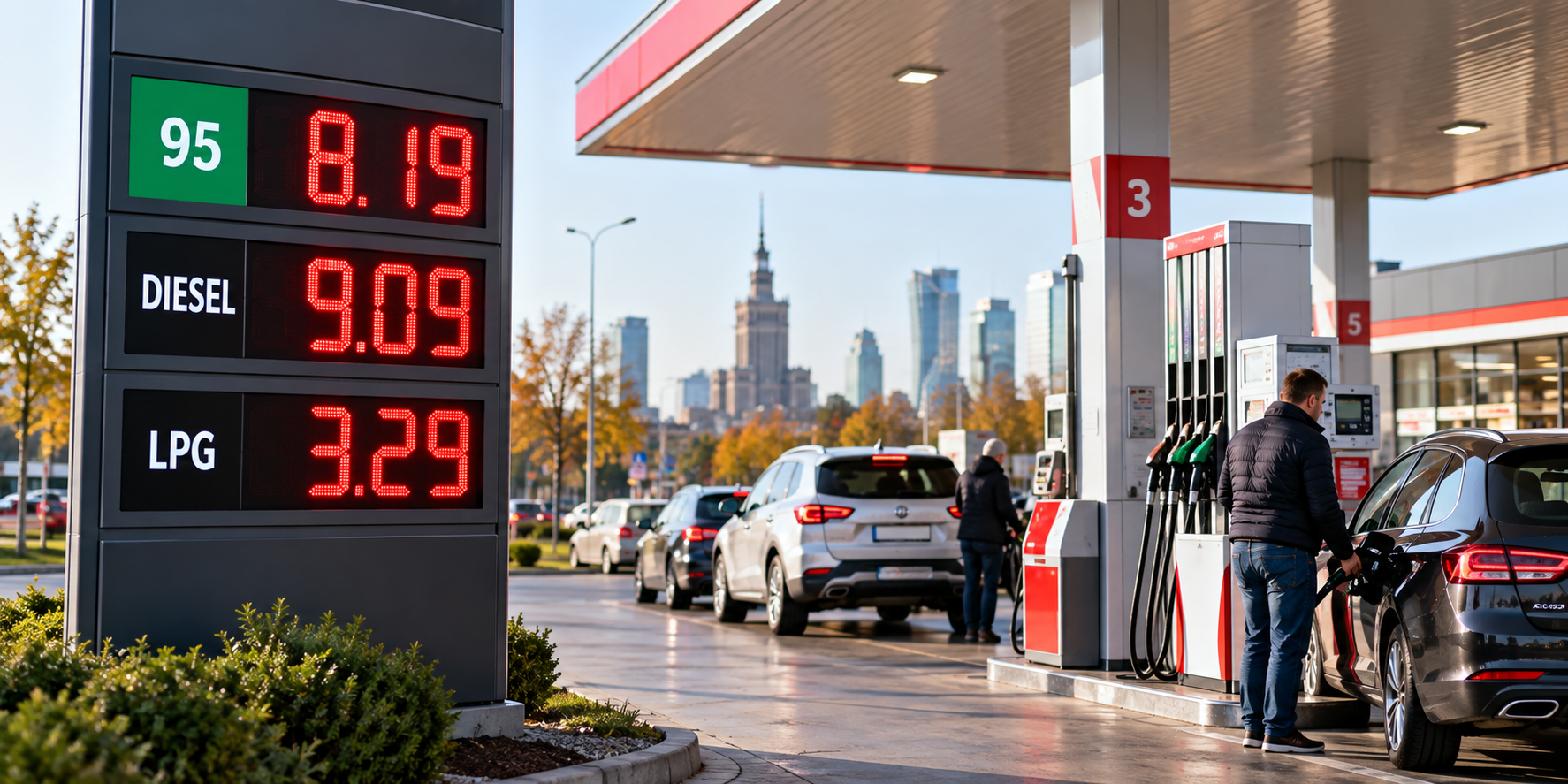
A Monday morning survey of nine major-brand and supermarket stations found Pb95 prices ranging from PLN 7.89 to PLN 8.19 per litre, while ordinary diesel ranged from PLN 8.89 to PLN 9.19. The survey published by Dziennik.pl found PLN 8.19 petrol at several large networks and diesel above PLN 9 at most of those it visited.
Those observations should not be confused with a national average.
The latest published nationwide figures from fuel-market analyst e-petrol.pl , dated 23 September, put the average price of Pb95 at PLN 7.99 per litre, diesel at PLN 8.99 and LPG at PLN 3.14.
E-petrol updates its national retail average on Wednesdays, meaning Monday’s sharp station-level readings have not yet been incorporated into a newer nationwide figure.
For the week of 28 September to 4 October, however, its forecast already places Pb95 in a range of PLN 7.97–8.09, diesel at PLN 8.99–9.29 and LPG at PLN 3.14–3.24.
Reflex is slightly less pessimistic on petrol and diesel, with its latest forecast cited by Auto Świat putting the expected averages at about PLN 7.97 for Pb95 and PLN 9 for diesel.
Fuel is dramatically more expensive than a year ago
The latest national averages show how quickly the cost environment has changed.
One week earlier, on 16 September, e-petrol put Pb95 at the same PLN 7.99, diesel at PLN 8.89 and LPG at PLN 3.08. Diesel has therefore risen another 10 groszy and LPG six groszy in a week, while petrol has remained exceptionally high.
The comparison with late August is much sharper.
On 26 August, while the government’s temporary CPN fuel-support package was still operating, e-petrol reported average Pb95 at PLN 6.57, diesel at PLN 7.51 and LPG at PLN 2.91.
Against those levels, the latest averages are PLN 1.42 higher for petrol and PLN 1.48 higher for diesel in roughly four weeks.
A year-on-year comparison is larger still.
E-petrol figures reported on 24 September 2025 put average Pb95 at PLN 5.83, diesel at PLN 5.96 and LPG at PLN 2.64.
Compared with those figures, Pb95 is now around 37% more expensive, while diesel is about 51% higher. LPG is roughly 19% more expensive.
For a 50-litre fill, that means petrol at the latest national average costs approximately PLN 399.50, compared with PLN 291.50 a year ago — around PLN 108 more.
A 50-litre diesel fill has risen from approximately PLN 298 to PLN 449.50, an increase of about PLN 151.50.
For international comparison, PLN 8 per litre is approximately $2.08 or €1.83 per litre, while PLN 9 is around $2.34 or €2.06, using the National Bank of Poland’s latest available average rates from 25 September.
Why Polish fuel prices remain so high
The retail increases reflect a combination of international oil-market pressure, Polish wholesale prices and unusually tight station margins.
In its latest weekly market commentary, e-petrol said wholesale Pb95 had risen by PLN 123 per cubic metre between 19 and 25 September, reaching PLN 6,469 per cubic metre.
Pb98 wholesale prices rose by PLN 184 to PLN 7,291.
Wholesale diesel moved in the opposite direction over that particular comparison period, falling PLN 41 to PLN 7,483 per cubic metre, but e-petrol said retail diesel margins had been compressed to almost nothing as stations tried to hold prices below the psychologically important PLN 9 threshold.
The international backdrop remains unstable.
E-petrol reported Brent crude back above $105 per barrel on Friday morning, after briefly falling below $100 earlier in the week, as expectations of renewed US-Iran diplomacy weakened and geopolitical uncertainty in the Middle East returned to the market.
The market is also watching discussion in the United States over possible restrictions on diesel exports, which could further affect internationally traded diesel supplies.
That matters particularly for Poland because diesel pricing is heavily exposed to international markets.
The end of CPN made the rise much more visible
The current prices also follow the expiry of the government’s temporary CPN — “Ceny Paliwa Niżej”, or “Fuel Prices Lower” — intervention.
The programme operated from 17 to 31 August and combined a temporary reduction in VAT on fuel from 23% to 8% with government-set maximum retail prices. The Energy Ministry’s final CPN price notice capped Pb95 at PLN 6.64 per litre and diesel at PLN 7.31 for 29–31 August.
Those controls expired at the end of August.
Compared with those final caps, today’s PLN 8-plus petrol and PLN 9-plus diesel readings illustrate how much of the underlying market pressure was being absorbed by the temporary intervention.
The government has since linked the possibility of another CPN-style intervention to legislation imposing a temporary windfall tax on extraordinary fuel-sector revenues.
Windfall-tax legislation has cleared parliament
The government’s latest windfall-tax legislation passed the Sejm on 18 September and was approved by the Senate without amendments on 24 September. The Senate’s legislative record shows that the final parliamentary version covers fuel-sector revenues from March 2026 to March 2027.
The measure uses a 60% headline rate applied to a specially calculated extraordinary-revenue tax base rather than to a company’s entire profit.
The government has presented the measure as a source of funding for renewed fuel-price support.
As of the morning of 28 September, however, the legislation had not appeared on the Presidential Chancellery’s list of laws signed in September, meaning it should still be treated as parliament-approved legislation awaiting presidential action.
The Presidential Chancellery has said constitutional concerns raised against an earlier version remain relevant, particularly because the proposed tax would reach back to economic activity beginning in March even though the new legislation is intended to enter into force later. That is the Chancellery’s stated legal position; the legislation’s final outcome remains unresolved.
The president has proposed a different fuel-price mechanism
President Karol Nawrocki has meanwhile submitted his own proposal, called “Paliwo Kosztuje Normalnie”, or “Fuel Costs Normally”.
The Presidential Chancellery says the proposal would temporarily exempt retail fuel sales from the retail sales tax, restore greater flexibility to reduce excise duty and introduce statutory limits on refinery, import and wholesale margins.
The project was submitted to the Sejm on 18 September and has been sent for opinions.
The government and Presidential Chancellery disagree over the likely effects of the competing approaches, including their impact on fuel imports, company margins and state finances.
For motorists and businesses, neither political proposal currently changes the price displayed at the pump.
Why diesel above PLN 9 matters beyond motorists
The most immediate impact is felt by households filling their cars, but diesel prices have a wider economic importance because of the fuel’s role in commercial transport.
Road freight, delivery fleets, construction equipment, agricultural machinery and many business vehicles rely heavily on diesel.
Sustained prices around or above PLN 9 therefore increase operating costs for businesses whose fuel consumption cannot easily be reduced.
How much of that ultimately passes into consumer prices depends on individual sectors, contracts, competition and how long the price increase lasts, so the current fuel spike should not by itself be translated into a specific inflation effect.
Poland’s next consumer-price release will nevertheless be closely watched for evidence of how energy and transport costs are feeding into the broader economy.
What happens next
The next scheduled nationwide e-petrol retail-price update is due on Wednesday.
That will provide the first national average incorporating more of the price changes now appearing at individual stations.
For this week, the direction remains unusually uncertain.
E-petrol’s forecast leaves room for average Pb95 to move above PLN 8 and diesel as high as PLN 9.29, while Reflex expects petrol closer to PLN 7.97 and diesel around PLN 9.
What is already clear is that the PLN 8 and PLN 9 thresholds are no longer theoretical.
They are appearing on Polish station pylons now.