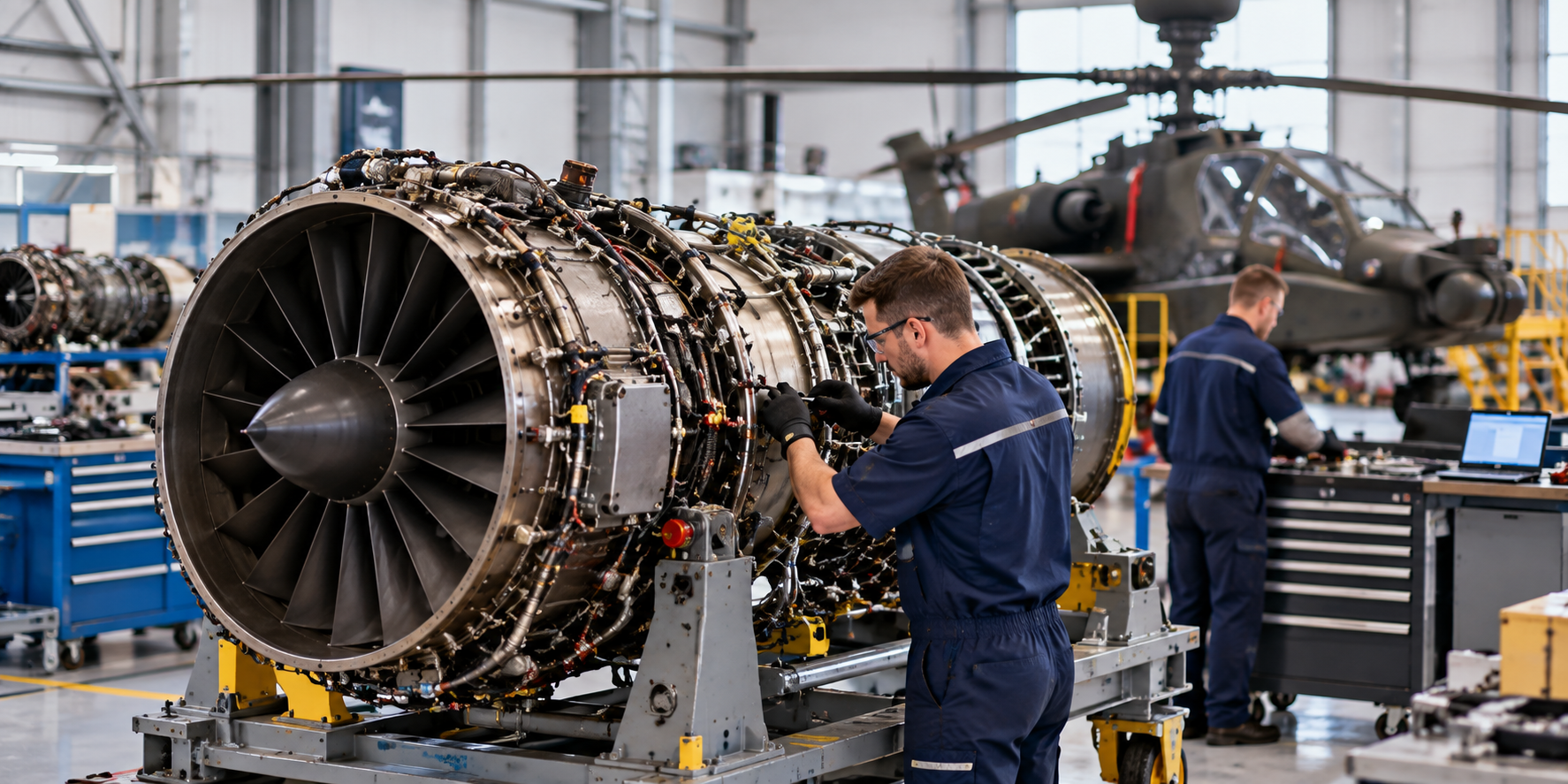
Poland is establishing licensed maintenance and overhaul capability for a family of helicopter engines used by its incoming Apache attack helicopters and several other military aircraft, creating a new defence-industry business at Wojskowe Zakłady Lotnicze No. 1 in Dęblin.
Representatives of WZL-1 and GE Aerospace signed the implementing agreement in Dęblin on 28 September, completing a key part of the industrial package connected with Poland’s purchase of 96 Boeing AH-64E Apache Guardian helicopters.
The agreement gives WZL-1’s Dęblin branch licensed maintenance, repair and overhaul capability for GE Aerospace’s T700 and CT7 family of turboshaft engines.
That means the facility will not be limited to Poland’s future Apache fleet.
The same engine family is used in other helicopters already operated or being introduced by the Polish Armed Forces, including S-70i Black Hawks, Leonardo AW149s and AW101s.
The result is a substantially wider potential maintenance market than the Apache programme alone.
More than PLN 530 million of engine-service capability
The project stems from the offset agreement signed between Poland and General Electric in August 2024.
The Ministry of National Defence said when that agreement was concluded that the GE package contained six offset commitments worth more than PLN 530 million.
At the National Bank of Poland’s 28 September average exchange rates, that is approximately $138 million or €121 million.
The programme covers the transfer of technology and know-how required for WZL-1’s Dęblin branch to maintain and repair T700-701D, CT7-2E1 and CT7-8E engines up to depot level — the deepest maintenance level covered by the arrangement.
The 28 September agreement puts those earlier commitments into an executable industrial framework between WZL-1 and GE Aerospace.
It is therefore more than a general cooperation memorandum: Poland is acquiring licensed technical capability intended to allow substantial engine work to be performed domestically.
Apache creates the anchor customer
The largest future source of work will be Poland’s AH-64E fleet.
Poland ordered 96 Apache Guardian helicopters in 2024, making the programme one of the country’s largest defence procurements.
GE Aerospace subsequently received an order for 210 T700 engines to support the fleet, including spare engines in addition to those installed on the aircraft.
Current delivery plans reported from Monday’s ceremony put the arrival of Poland’s 96 aircraft in the 2028–2032 period.
That creates a long-term domestic maintenance requirement extending well beyond the initial helicopter delivery programme.
Instead of sending engines abroad for major maintenance throughout the aircraft’s service life, Poland is building part of that support capability into its own defence-industrial base.
The business case extends beyond Apache
The industrial value of the project comes partly from the fact that the T700/CT7 family is already spread across several Polish helicopter fleets.
GE Aerospace has previously confirmed that Poland operates T700-powered S-70i Black Hawks as well as CT7-powered AW149 and AW101 helicopters.
The Dęblin capability is therefore intended to support engines from:
- Boeing AH-64E Apache Guardian attack helicopters;
- Sikorsky S-70i Black Hawk helicopters;
- Leonardo AW149 helicopters; and
- Leonardo AW101 helicopters.
That creates a common maintenance capability across several fleets rather than a single-purpose Apache workshop.
For WZL-1, it also supports the company’s broader transition from maintaining Soviet-designed aircraft and engines towards Western systems operated to NATO standards.
Allied servicing is a potential market, not yet a contract
The agreement could eventually give Dęblin a customer base beyond the Polish Armed Forces.
Deputy Defence Minister Cezary Tomczyk said during Monday’s signing ceremony that the centre could provide services for US forces operating in Europe as well as other allied countries using aircraft powered by the same engine families.
He described the facility as potentially serving the US Army in Europe and other allied operators.
That should currently be understood as an addressable future service market, rather than confirmation that WZL-1 has already received maintenance contracts from the US military or another NATO country.
No separate US or allied MRO award was identified in the material reviewed for this article.
Winning such contracts would turn the industrial capability created for Poland’s own procurement into an exportable service business.
Poland is buying technology as well as maintenance
The underlying offset agreement goes beyond authorising WZL-1 to carry out routine inspections.
The Polish Armed Forces’ Armament Agency described the GE package as including technology and know-how transfer allowing the Dęblin plant to conduct service and repair work on the relevant engines up to depot level.
That matters because depot-level maintenance involves deeper repair and overhaul capability than routine operational servicing.
The programme also includes technical training.
Under the original cooperation structure, the Military University of Technology in Warsaw is responsible for managing T700/CT7 training for Polish technicians, military personnel and WZL-1 employees.
GE Aerospace said when the cooperation was first announced that the programme would bring new engine-MRO technologies, training and technical assistance into the Polish defence-industrial base.
No specific employment figure disclosed
The programme is also expected to require additional specialised staff.
WZL-1 has said more broadly that its new Western-engine and helicopter programmes require recruitment and training of engineers and aviation mechanics, while GE Aerospace has described the cooperation as supporting high-value jobs in Poland.
However, no verified figure for the number of jobs created specifically by the T700/CT7 centre was disclosed in the sources reviewed for this article.
WZL-1 therefore faces a second challenge alongside obtaining the technology itself: building a sufficiently large pool of technicians qualified to work on Western military engines.
That issue is becoming increasingly important as Poland simultaneously expands its Apache, AW149, AW101 and other modern aircraft fleets.
A wider Polish MRO strategy is emerging
The GE project is one part of a broader build-out of WZL-1’s maintenance capabilities.
Separate Apache-related agreements are transferring capability for other aircraft systems, including airframe components, avionics and Longbow radar support.
WZL-1 is also developing engine-maintenance capability for the AGT1500 gas turbines used in Poland’s Abrams tanks.
Taken together, those projects are repositioning the company around maintenance of newly acquired US and Western equipment.
For Poland, that reduces reliance on overseas servicing.
For WZL-1, the longer-term commercial opportunity is to use the scale of Polish defence procurement as the anchor for maintenance services that can eventually be sold to other European operators.
What happens next
The immediate task is to establish the equipment, trained workforce, licences and processes required to perform the contracted work in Dęblin.
The first Polish AH-64E deliveries are currently planned from 2028, while other T700- and CT7-powered helicopters are already in Polish service.
That means WZL-1 does not necessarily need to wait for Poland’s Apache fleet to mature before the engine capability becomes commercially useful.
The bigger question is whether the facility can move beyond supporting Polish government fleets and secure engine work from US forces and allied operators elsewhere in Europe.
Monday’s agreement creates the technical foundation for that possibility.
It does not yet guarantee the foreign customers.