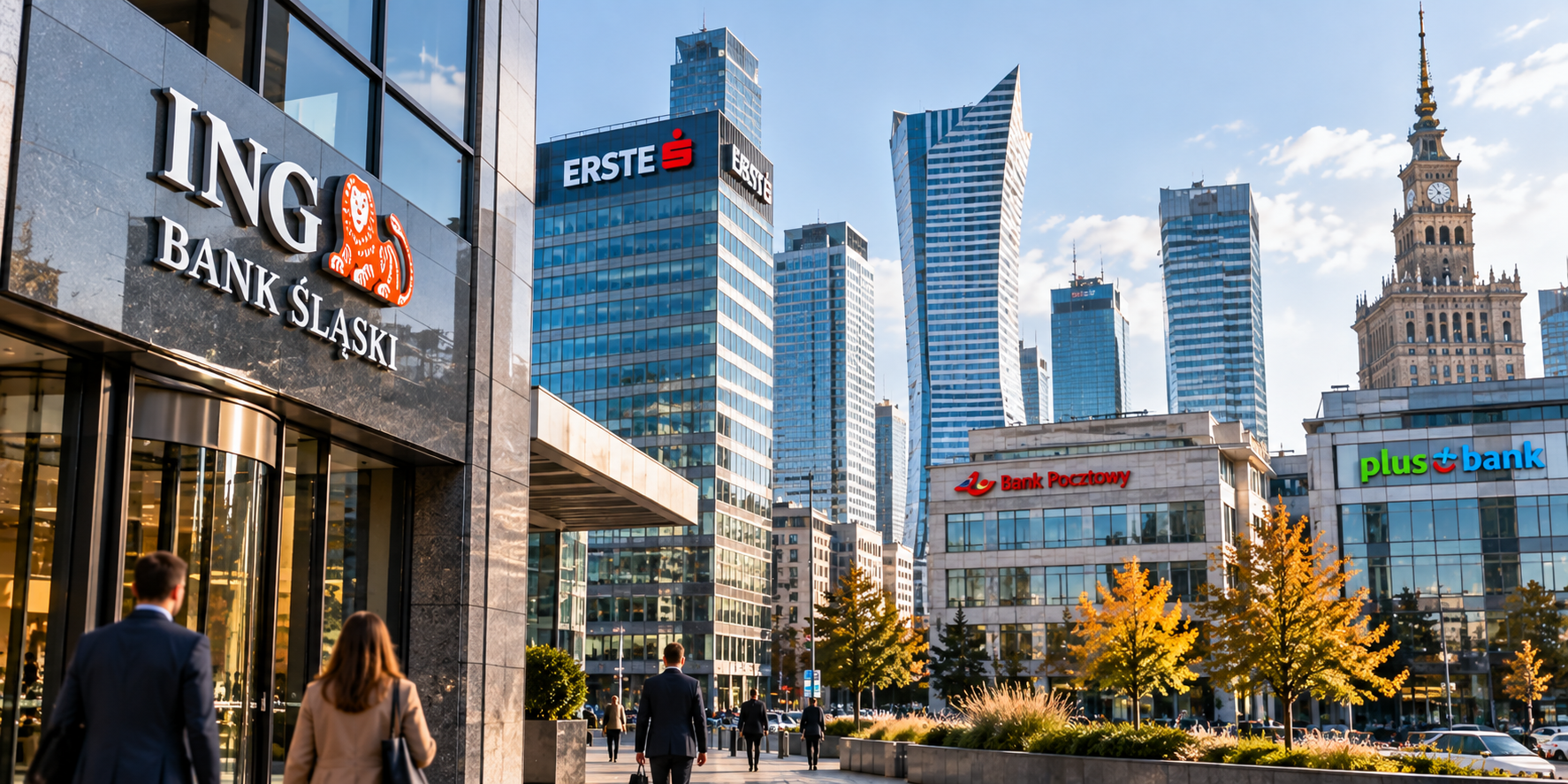
Poland’s competition and consumer-protection authority has imposed penalties totalling PLN 147.09 million — approximately $37.5 million or €33.5 million — on four banks over contractual clauses that allowed them to change consumer agreements or increase fees under conditions the regulator considered insufficiently clear.
The Office of Competition and Consumer Protection, UOKiK, announced the four decisions on 12 October.
The penalties are:
- Erste Bank Polska — PLN 80.68 million
- ING Bank Śląski — PLN 63.25 million
- Bank Pocztowy — PLN 2.71 million
- Plus Bank — PLN 453,000
Each institution received two penalties covering different categories of contractual provisions: clauses governing unilateral changes to agreements and clauses concerning changes or additions to fees and commissions.
The decisions are not final. Each bank can appeal to Poland’s Court of Competition and Consumer Protection.
The regulator objected to how banks reserved the right to change contracts
The cases concern so-called modification clauses — contractual provisions specifying when a bank can change the terms of an agreement that has already been signed.
Such provisions are not automatically unlawful.
UOKiK’s position is that they must make it possible for a consumer to understand in advance what event can trigger a change, what part of the agreement can be altered and how extensive that change could be.
The authority said the challenged clauses were used across consumer products including bank accounts, payment and credit cards, personal loans and mortgages.
That matters because many of those relationships can last for years or decades.
A bank may legitimately need to adapt contracts to legal, technological or economic developments, but UOKiK argues that this does not give it an open-ended right to redesign a customer’s existing agreement.
Some clauses could permit fee increases of up to 200%
One of the strongest examples cited by UOKiK involved ING Bank Śląski.
According to the regulator, one provision allowed fees and commissions to rise by as much as 200% following relatively small changes in indicators, including a 0.30-percentage-point rise in inflation or a 1% increase in average wages.
UOKiK argued that the mechanism could enable repeated fee increases even where the economic change used to justify them was modest.
The regulator also challenged broadly drafted provisions that referred to documents or positions issued by regulators or other bodies without allowing consumers to identify precisely which external event would justify a contractual change.
ING disputes that assessment.
In a statement issued on 12 October, ING Bank Śląski said it intends to challenge the UOKiK decision.
The bank said the clauses were designed to allow long-term services to adapt to changes in law, technology, customer preferences and economic conditions.
ING also said the proceedings had lasted for more than ten years and that the challenged clauses appeared in previously used contract templates that had since been withdrawn as products and services were replaced.
Erste clauses covered inflation, wages and new charges
UOKiK also highlighted provisions used by Erste Bank Polska.
The challenged mechanism allowed the bank to change its tariff when specified economic indicators moved, including inflation and average wages.
One provision also allowed a service that had previously cost PLN 0 to acquire a charge of up to PLN 200, or a percentage fee previously set at zero to rise to as much as 2%.
UOKiK did not argue that inflation or higher operating costs can never justify a fee change.
Its objection was that simply identifying a broad economic indicator is not sufficient if customers cannot establish the relationship between the indicator and the particular charge being altered.
The authority said consumers should be able to understand why a specific economic change affects a specific fee and how the size of any adjustment will be calculated.
Plus Bank provisions referred to broad operating costs
In the case of Plus Bank, UOKiK criticised contractual wording that allowed charges to change following increases in costs including energy, telecommunications, postal services, transaction processing and other costs paid to external institutions.
The problem, in the authority’s assessment, was the open-ended nature of the wording.
A reference to other costs borne by a bank did not allow customers to determine in advance exactly what expenditure could later be used to justify a higher charge.
UOKiK also stressed that ordinary increases in the costs of running a business cannot automatically be transferred to consumers simply because the bank’s own expenses have risen.
Bank Pocztowy clause referred to improving services
Bank Pocztowy was cited for a different type of provision.
One credit-card contract allowed changes to the regulations following an expansion of the bank’s product or service range or an “improvement” of existing services or products.
UOKiK considered that wording too broad because it did not adequately distinguish between minor improvements and changes to important contractual terms.
According to the authority, the provision could potentially encompass issues as significant as repayment arrangements or the form of security attached to credit.
Customers being allowed to leave was not enough
Banks commonly notify customers before contractual changes take effect and allow them to reject the new terms by ending the agreement.
UOKiK said that safeguard does not necessarily solve the problem.
For an ordinary current account, changing provider may be relatively straightforward.
For a borrower, however, terminating a contract can have much more serious consequences.
A consumer with outstanding debt may need to repay it immediately or find alternative financing, potentially on worse terms.
The authority therefore argues that the original mechanism permitting unilateral changes must itself meet transparency requirements rather than relying on customers’ ability to leave the relationship afterwards.
What the decisions could mean for existing contracts
The decisions concern consumer contracts, not banking agreements with companies generally.
They should therefore not be interpreted as a finding that equivalent wording in every corporate or SME banking contract is unlawful.
For consumers, however, the implications can extend beyond future contract templates.
UOKiK’s general guidance on unfair contractual provisions explains that a provision found to be unfair does not bind a consumer by operation of law.
Once a UOKiK decision becomes final, its finding can apply to the company concerned and consumers who entered contracts based on the contractual template identified in the decision.
That can also assist customers pursuing individual claims connected with the use of an unfair provision.
It does not, however, mean that every affected customer automatically receives a refund following the 12 October announcement.
The present decisions can still be challenged in court, and any individual financial claim may depend on how the relevant clause was actually used in a particular contract.
The cases reflect wider EU consumer-contract rules
The issue is not unique to Poland.
EU consumer law places particular emphasis on transparency where businesses use standard-form contracts that customers do not individually negotiate.
UOKiK pointed to Court of Justice of the European Union judgments including C-472/10 Invitel and C-26/13 Kásler in support of the requirement that mechanisms affecting consumers’ contractual obligations must be sufficiently transparent and understandable.
For banks, this creates a compliance challenge.
Long-term financial products inevitably operate in changing economic and regulatory conditions, so institutions need contractual mechanisms allowing some adaptation.
But the more broadly those clauses are drafted, the greater the risk that consumer authorities or courts conclude that customers could not reasonably predict their economic consequences when signing the agreement.
ING will appeal
ING is the first of the four banks for which a detailed public response was identified following the announcement.
The bank said it disagrees with UOKiK’s assessment and intends to appeal.
It also stressed that it had cooperated with the authority throughout the proceedings and that customers were informed in advance of changes and given the option of ending their contractual relationship.
That dispute will now move into the appeal process if ING files its challenge as announced.
No equivalent detailed public response from Erste Bank Polska, Bank Pocztowy or Plus Bank had been identified by Poland 24 Business at the time of publication.
Regulatory risk extends beyond the headline fine
For investors, the immediate headline is the PLN 147.09 million aggregate penalty.
Erste and ING account for the overwhelming majority of that amount.
But the wider issue for the banking sector is how the decisions affect the drafting and operation of consumer agreements.
Banks need mechanisms that allow long-running contracts to respond to regulatory changes, inflation, technology and operating costs.
UOKiK’s decisions indicate that those mechanisms can themselves create regulatory exposure when the triggers or limits are drafted too broadly.
The consequences could therefore extend beyond the four penalties if banks across the sector review their own modification clauses, fee schedules and procedures for changing existing agreements.
For now, however, the legal status remains straightforward: UOKiK has issued four administrative decisions and imposed PLN 147.09 million in penalties, but those decisions are not final and can be challenged before the Court of Competition and Consumer Protection.