The European Commission has blocked PLN 116.3 million of Polish state aid for MAN Trucks’ factory in Niepołomice, ruling that Warsaw failed to prove the subsidy was necessary to persuade the company to make the investment in Poland.
The package was worth about €26 million in the Commission’s state-aid case, or roughly $30 million at current exchange rates, and was intended to support a major expansion of MAN’s truck-manufacturing operation in the Małopolskie region.
The crucial practical point is that Brussels is not stopping the factory expansion.
The investment covered by the case has already been completed and is operating. The Commission’s decision instead means Poland cannot provide the financial support that had been promised subject to EU approval.
Reuters reported the Commission’s final decision on 5 October, with Brussels concluding that the support lacked the required “incentive effect” and had not been shown to be proportionate.
Most of the support was a corporate tax exemption
The proposed assistance consisted of two elements.
Poland planned a direct cash grant of up to PLN 10.735 million, alongside a much larger PLN 105.551 million corporate-income-tax exemption.
Together, the measures had a nominal value of PLN 116.286 million.
The Commission’s detailed state-aid case documentation shows that the CIT exemption was granted conditionally in June 2021 and the direct grant agreement followed in December 2021.
Both contained provisions preventing the assistance from taking effect unless the European Commission approved it.
That matters because this is not a case in which Brussels has ordered Poland to recover €26 million already transferred to MAN.
The aid remained conditional on approval.
The final negative decision means it now cannot be disbursed.
The investment itself is already finished
The timing makes the case unusual from a business perspective.
MAN began work on the Niepołomice investment on 15 June 2021.
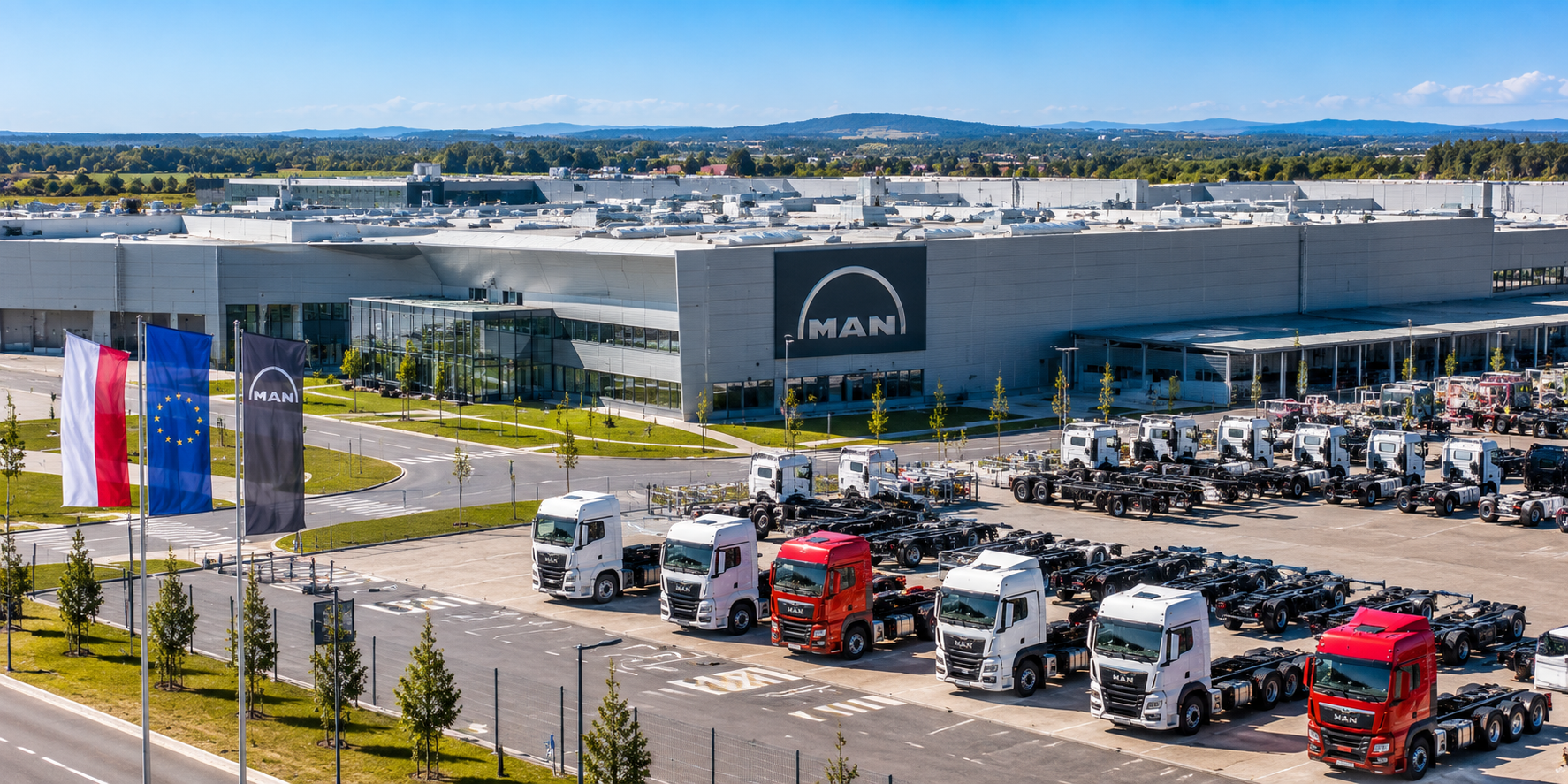
The project involved buildings, plant and machinery intended to increase production capacity at the existing truck factory.
According to the Commission’s case file, the investment was expected to increase annual capacity from a range of roughly 15,000–25,000 vehicles to around 60,000–70,000 vehicles and was associated with plans to create up to 1,400 additional jobs.
By the time Poland formally notified the aid measure to the Commission in June 2024, however, the expansion had already been completed and was operating.
The issue before Brussels was therefore no longer whether the physical factory should be built.
It was whether Poland was legally entitled under EU state-aid rules to give MAN the financial support promised for choosing Niepołomice.
Brussels says Poland did not prove the subsidy changed MAN’s decision
Regional investment aid to large companies can be permitted under EU rules, particularly in economically weaker regions.
Małopolskie qualified for regional assistance under the aid framework applicable when the MAN support was awarded.
But eligibility of the region is not enough.
For large investment projects, authorities generally need to demonstrate an incentive effect — in practical terms, that the public assistance genuinely changed the company’s behaviour.
Poland argued that without the support MAN could have located the investment at an alternative site outside the European Economic Area.
During the Commission’s investigation, Polish authorities submitted company documents comparing Niepołomice with that alternative location.
But the Commission was not persuaded that the evidence demonstrated the Polish subsidy had actually been decisive.
In its final decision, Brussels concluded that the evidence did not show that MAN would have chosen another location without the support.
That makes the economic logic important: state aid is not intended simply to subsidise an investment a company would have made in the same region anyway.
What “incentive effect” means for investors
The case provides a useful lesson for companies considering major investment incentives in Poland.
An incentive programme may promise a tax exemption or grant, but where EU state-aid approval is required, the government needs evidence showing that the support genuinely influences the investment decision.
This can involve contemporaneous board papers, competing location assessments, financial models and evidence of the incentives realistically available at alternative sites.
In the MAN investigation, the Commission questioned aspects of the alternative-location scenario.
Its earlier formal-investigation decision said that without some of the incentives assumed for the competing location, the Niepołomice investment appeared to be financially more attractive anyway.
That weakened Poland’s argument that the state aid was needed to overcome a location disadvantage.
Commission also rejected Poland’s proportionality case
The second problem was proportionality.
Even where public assistance genuinely changes an investment decision, EU regional-aid rules require the amount of support to be limited to what is necessary.
Poland calculated the discounted value of the proposed aid at about PLN 112.4 million, against eligible investment costs of approximately PLN 419.5 million.
That produced an aid intensity of about 26.8%.
But being below or at a numerical aid ceiling does not by itself prove that the entire amount is necessary.
The Commission concluded that Poland had not demonstrated that the proposed support was limited to the minimum required to secure the investment.
Because Brussels found problems with both the incentive effect and proportionality, it concluded that the measure was incompatible with EU state-aid rules.
Poland is consequently prohibited from implementing it.
This concerns an older MAN expansion
The case should not be confused with MAN’s much larger new investment programme announced in 2026.
The blocked assistance relates to the earlier Niepołomice expansion whose investment decision dates back to 2021 and which was subsequently completed.
MAN is now preparing another phase of development at the Polish plant.
The company announced in 2026 that it intends to invest heavily in Niepołomice as part of its MAN2030+ strategy, including new body-production and paint facilities for the next generation of trucks.
More recently, MAN announced an investment memorandum with the Polish government covering approximately €1.2 billion of investment through 2038.
The company says the first phase will expand the Niepołomice facility substantially by 2030 and prepare it to produce the next generation of trucks based on the TRATON Modular System.
That newer programme is separate from the investment examined in state-aid case SA.114436.
The Commission’s 5 October decision should therefore not be interpreted as Brussels blocking MAN’s current €1.2 billion expansion plan.
Niepołomice has already become a major MAN production hub
The earlier investment fundamentally expanded the role of the Polish plant.
MAN says the 2022–2023 expansion substantially increased the factory’s size, workforce and production capability.
The Niepołomice operation can now produce the company’s light, medium and heavy truck ranges and has become a major volume-balancing plant within MAN’s European production network.
The company’s current Polish investment plans would go further by bringing additional cab bodywork, painting and production processes into the site.
That makes the Commission decision financially relevant to MAN and the Polish state, but it does not undo the industrial development that has already taken place.
Why the CIT element matters for companies considering Poland
For other international businesses, the most relevant part of the case may be that around 91% of the nominal support package was a corporate-income-tax exemption rather than a direct cash subsidy.
Poland frequently uses investment incentives and tax relief to attract large industrial projects.
The MAN decision demonstrates that tax exemptions can constitute state aid in exactly the same way as a direct government payment.
Where a large individual award requires Commission clearance, the tax benefit cannot safely be treated as final simply because a domestic investment-support decision has already been issued.
In MAN’s case, the Polish support decision expressly contained a suspension mechanism pending EU approval.
The company could proceed with the investment, but the financial incentive remained exposed to the outcome of the European state-aid procedure.
Poland notified the aid only after the expansion was operating
Poland formally notified the package to Brussels on 6 June 2024.
The Commission then requested further information from the Polish authorities and held meetings with both Poland and MAN.
On 28 July 2025, Brussels opened a formal investigation after concluding that there were serious doubts over the proposed support.
That investigation examined whether the alternative-location argument was credible, whether the subsidy genuinely affected MAN’s investment decision and whether the amount was proportionate.
The proceedings have now ended with a negative decision.
Under the Commission’s state-aid procedure, a negative decision on notified aid means that the measure is incompatible with the internal market and cannot be implemented.
No repayment issue because the aid was suspended
The distinction between blocking and recovering state aid is important.
When incompatible aid has already been paid, the Commission can generally order the Member State to recover it from the beneficiary, with interest.
Here, the Commission’s case documentation shows that the grant and tax exemption were made conditional on Brussels approving them.
The practical consequence of the 5 October decision is therefore that Poland cannot now provide the support, rather than MAN being required to repay aid that had already been lawfully disbursed.
The physical factory investment remains in place.
The decision can still face judicial review
Commission state-aid decisions are subject to judicial review by the EU courts.
The Commission’s explanation of the state-aid procedure confirms that its decisions can be reviewed by the General Court and ultimately the Court of Justice of the European Union.
As of publication, no decision by Poland or MAN to challenge the 5 October ruling has been identified.
Any appeal would concern the legality of the Commission decision; it would not automatically convert the blocked assistance into approved aid.
A significant test for Polish investment incentives
For Poland, the MAN case matters beyond the approximately €26 million directly involved.
The country actively uses regional investment incentives, including corporate-tax exemptions, to attract manufacturing projects.
The Commission decision reinforces the requirement that for large projects requiring individual EU approval, Poland must be able to prove not simply that an investment benefits a region but that the aid itself was genuinely necessary to secure it and was no larger than required.
For MAN, the immediate result is straightforward.
The truck plant that the support was intended to encourage is already operating in Niepołomice.
But the Polish state will not be allowed to provide the PLN 116.3 million incentive package attached to that investment.