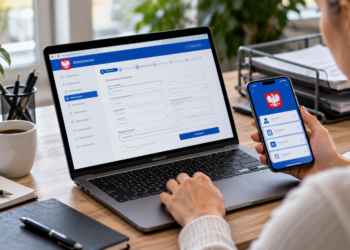

A major remaining group of Polish entrepreneurs has only days left to activate its official electronic-delivery address, as the final broad CEIDG deadline for Poland’s e-Doręczenia system takes effect on 1 October 2026.
Entrepreneurs entered in the Central Register and Information on Economic Activity, or CEIDG, before 1 January 2025 must have an active address for electronic deliveries — known as an ADE — from that date.
The government has explicitly reminded affected businesses that they need both to create the address and activate the associated mailbox. An address that has merely been created but not activated is not enough to complete the process.
The requirement is particularly important for sole traders and other individual entrepreneurs because e-Doręczenia is not simply another optional government inbox. It provides legally recognised electronic delivery equivalent to a registered letter with acknowledgement of receipt.
Who faces the 1 October deadline?
The new deadline applies to entrepreneurs registered in CEIDG by 31 December 2024 who have not already become subject to the requirement through an earlier trigger.
Businesses established through CEIDG from 1 January 2025 have already been required to create their e-Doręczenia arrangements as part of the registration process.
Older CEIDG businesses that changed their registration details after 30 June 2025 were also required to deal with e-Doręczenia when submitting that update.
From 1 October 2026, the remaining pre-2025 CEIDG cohort comes within the general obligation.
This means the date should not be described as the moment when e-Doręczenia first becomes compulsory for every Polish business.
Companies and other entities entered in the National Court Register, or KRS, had earlier deadlines. Businesses already registered in KRS before 1 January 2025 have been required to have an address since 1 April 2025, while businesses registering in KRS or CEIDG from the beginning of 2025 entered the system during registration.
The 1 October deadline effectively completes the main rollout among ordinary businesses registered in CEIDG.
What are ADE and BAE?
Two acronyms are central to the system.
ADE — adres do doręczeń elektronicznych — is the business’s electronic-delivery address.
It is the formal address through which legally recognised electronic correspondence can be sent and received.
BAE — Baza Adresów Elektronicznych — is the official Electronic Addresses Database maintained by the minister responsible for digital affairs.
The database contains registered electronic-delivery addresses used by public and non-public entities.
For businesses using the public e-Doręczenia service, activation causes the ADE to be entered automatically into the BAE.
Once that happens, public authorities using e-Doręczenia can locate the company’s address and send correspondence through the system.
Creating the address is not enough
This is one of the easiest points for businesses to miss.
Submitting the application starts the process, but the mailbox does not become operational simply because the electronic address has been created.
After the address and mailbox are prepared, the e-Doręczenia service sends an activation message to the e-mail address provided during the application process.
The entrepreneur — or administrator where one has been appointed — must then log into the Business Account, open the e-Doręczenia section and activate the mailbox.
Only after activation does the public-service ADE become entered in the BAE and the mailbox become available for sending and receiving correspondence.
For that reason, an entrepreneur approaching the deadline should check the status of the mailbox rather than assuming that an earlier application completed the obligation.
How to set up e-Doręczenia
The government’s public service is available online through Biznes.gov.pl.
For the standard public-service route, an affected entrepreneur should submit the electronic application, sign it electronically and then activate the mailbox when the activation instructions arrive.
The application can be signed using a trusted profile, qualified electronic signature or personal signature. The government says obtaining the address through the public service is free.
A CEIDG entrepreneur can manage the mailbox personally or appoint another person as its administrator.
That differs from the rules applying to KRS entities, where an administrator must be appointed.
Businesses can also use a qualified registered electronic-delivery service supplied commercially by an authorised provider. In that case, getting the external address into the BAE involves a different process rather than the automatic registration used with the public provider.
Why checking the mailbox matters
Once a company has an active ADE in the BAE, e-Doręczenia can carry correspondence with the legal effects associated with formal delivery.
The system records evidence of sending and receipt and is legally equivalent to a traditional registered postal item with acknowledgement of receipt.
That means businesses should treat the mailbox as an operational compliance channel rather than simply a digital archive.
Government guidance explains that correspondence sent by a public entity to a citizen, company or other non-public entity can be deemed successfully delivered after 14 days from its arrival at the electronic address even if the recipient has not opened it.
That makes internal responsibility for monitoring the mailbox important.
A sole trader who manages it personally should ensure notification e-mails go to an address that is checked regularly. Businesses delegating the task should make clear who is responsible for monitoring correspondence, downloading documents and escalating anything subject to an administrative or legal deadline.
Simply leaving an active mailbox unattended can therefore create practical problems even though the system itself is functioning correctly.
Does every letter from an authority now arrive through e-Doręczenia?
Not necessarily.
Since 1 January 2026, e-Doręczenia has become the principal form of electronic communication between many public and non-public entities where the law requires formal electronic delivery, but specific legislation can provide other methods or exceptions.
Businesses should therefore not assume that every interaction with every Polish public body will immediately move into one mailbox.
But where an authority uses e-Doręczenia for formal correspondence and the entrepreneur has an ADE registered in the BAE, the electronic address becomes an important official delivery channel.
What about ePUAP?
Businesses accustomed to Poland’s older ePUAP platform should also be careful not to treat it as an interchangeable replacement.
The transitional rules that broadly gave ePUAP deliveries equivalent effect ended at the end of 2025, and from 1 January 2026 e-Doręczenia became the primary electronic-delivery route for public-sector communications covered by the system, subject to exceptions under specific legislation.
Some services and proceedings may still use other electronic channels where separate rules allow them, but businesses should not assume that maintaining an ePUAP inbox satisfies the ADE requirement.
Foreign entrepreneurs should check their Polish registration
The 1 October rule is linked to the entrepreneur’s CEIDG status rather than where the owner happens to live.
That makes the deadline relevant to foreign nationals who operate businesses registered in CEIDG, including entrepreneurs who manage their Polish activities while spending substantial time outside Poland.
For those businesses, reliable remote monitoring may be particularly important because e-Doręczenia allows formal official correspondence to arrive without any physical letter reaching an office or residential address.
A CEIDG entrepreneur can appoint an administrator to manage the mailbox, which may be useful where accounting, compliance or administrative work is handled by another person.
Is there a fine for missing the deadline?
The government’s current deadline guidance focuses on the statutory obligation to possess an active ADE and does not identify a standalone automatic monetary penalty in its warning to CEIDG businesses.
Businesses should therefore avoid assuming that the main risk is a simple fixed fine.
The more immediate operational concern is that e-Doręczenia becomes part of the legally recognised infrastructure for official correspondence, with documented delivery and statutory delivery effects.
Entrepreneurs should consequently treat compliance as both a registration requirement and a process-management issue.
What businesses should do before 1 October
A CEIDG entrepreneur registered before 2025 should first establish whether an ADE is already active and registered in the BAE.
If not, the business should submit the application through Biznes.gov.pl without waiting until the deadline, monitor the e-mail address provided in the application for activation instructions and complete the activation step.
After activation, the entrepreneur should confirm that the address has entered the BAE and that the mailbox can be accessed.
The next task is organisational: decide who will check the mailbox, ensure notification details remain current and establish a process for handling official documents promptly.
That last step matters because the 1 October deadline is not simply about obtaining another identifier.
It marks the point at which the remaining established CEIDG businesses are expected to be reachable through Poland’s legally recognised electronic-delivery system.