
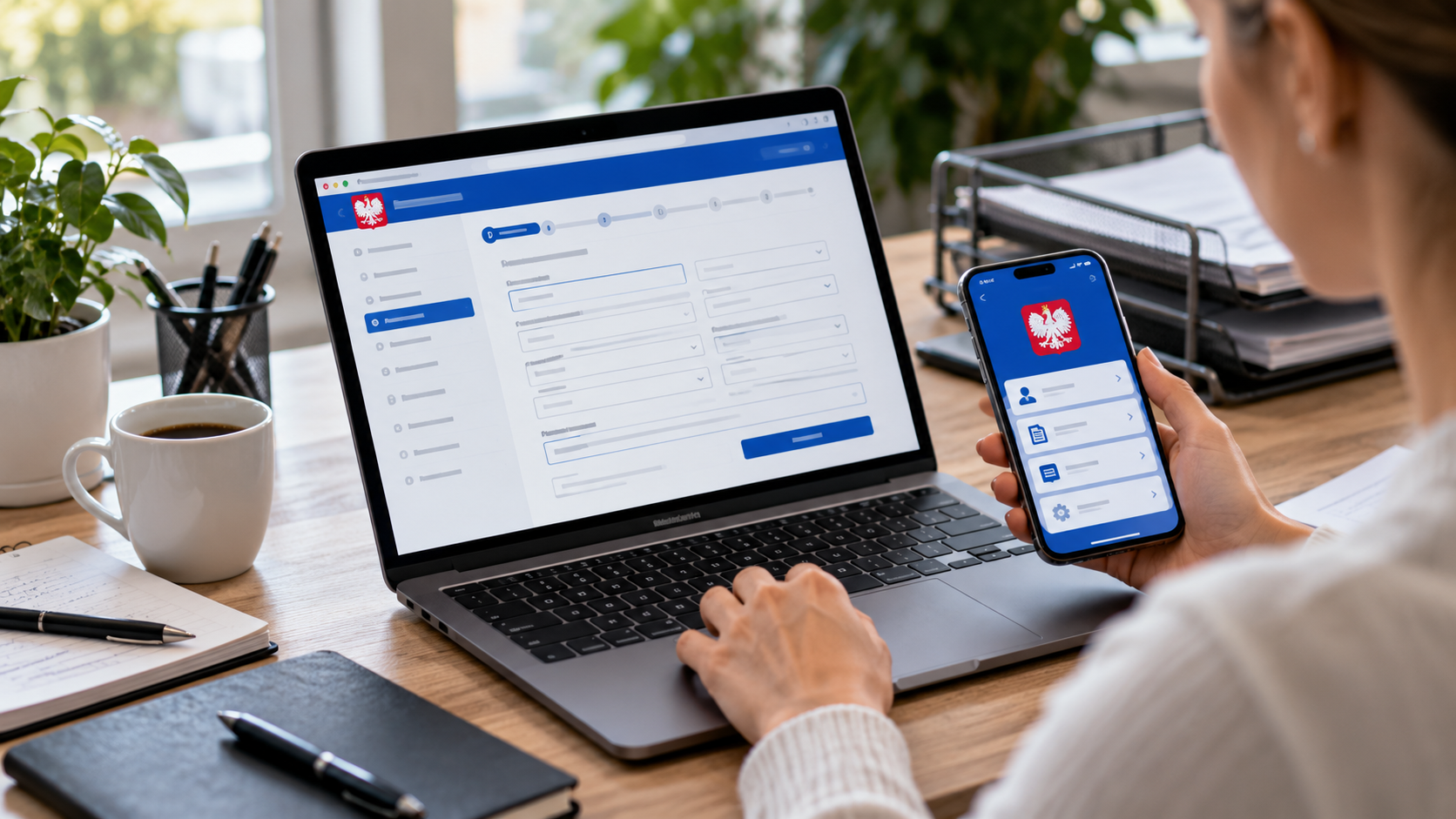
Poland will require new sole-trader businesses to be registered electronically from 1 November 2026, ending the ordinary paper application route through municipal offices as the government accelerates its transition towards digital business administration.
The change affects applications submitted to the Central Register and Information on Economic Activity (CEIDG), Poland’s national register for sole traders and other individual entrepreneurs.
Under legislation adopted earlier this year, adults establishing a new business will generally have to submit their registration applications online through government-approved digital services.
The Ministry of Digital Affairs published updated guidance on 26 October, highlighting the option of registering a first business through the government’s mObywatel mobile application.
Other registration channels remain available, including Biznes.gov.pl and supported banking and accounting platforms.
An exception applies to minor entrepreneurs, whose applications can continue to be submitted through municipal offices or by post during the transitional period.
The new requirement does not mean that all CEIDG procedures immediately become electronic-only. Applications to amend, suspend, resume or remove existing businesses can generally continue using current submission arrangements until 31 October 2028.
The changes are particularly relevant to first-time entrepreneurs, freelancers, returning Polish emigrants and foreign residents planning to establish businesses in Poland.
What changes on 1 November?
From Sunday, 1 November 2026, adult applicants registering a new business in CEIDG must generally complete the process electronically.
Previously, entrepreneurs could visit a municipal office, known as an urząd gminy, and submit a paper CEIDG-1 application.
Municipal officials would then enter the application into the electronic register.
That ordinary paper-registration option is being withdrawn for new adult sole traders.
The government’s official CEIDG registration guidance confirms that electronic submission will become the standard requirement.
Applications for new adult registrations submitted through the previous paper process after 31 October are not to be considered under the transitional provisions.
The change concerns registration in CEIDG, which primarily covers individuals operating sole-trader businesses, known in Poland as jednoosobowa działalność gospodarcza or JDG.
It also holds information about individuals participating in certain civil-law partnerships.
The reform should not be confused with the registration of limited companies and other commercial entities through Poland’s separate National Court Register, known as KRS.
Those businesses are subject to different registration procedures.
Importantly, the transition does not introduce a new charge for registering a sole-trader business.
CEIDG registration remains free.
How to register a business online
Prospective entrepreneurs have several electronic options.
The main registration service is Biznes.gov.pl, Poland’s official business information and administration portal.
Applicants can use its online registration process to complete the CEIDG-1 form and submit the necessary information to establish a business.
The portal uses the government’s Login.gov.pl identity system and supports recognised electronic signatures.
Depending on the applicant’s circumstances, these may include a trusted profile (Profil Zaufany), a qualified electronic signature or an eligible electronic identity-card signature.
The registration process involves providing personal and business information, including the entrepreneur’s name, identification details, proposed business name, address and planned economic activities.
Applicants must select the appropriate PKD codes, Poland’s official classification of economic activities, which identify the type of business being established.
They must also provide relevant tax and social-insurance information.
The electronic service can transmit registration details to other public institutions, including the tax administration, Statistics Poland and the Social Insurance Institution (ZUS).
Businesses without existing NIP tax-identification or REGON statistical numbers can have those details assigned through the registration process.
Applicants should also consider their income-tax arrangements, VAT obligations and whether their planned activities require separate permits or licences.
The registration application does not automatically replace every other administrative requirement associated with operating a business.
mObywatel offers a mobile registration option
The latest government announcement particularly promotes the Firma service within the mObywatel application.
The service, introduced in April 2026, allows eligible users to register their first sole-trader business directly from a smartphone.
According to the Ministry of Digital Affairs, the electronic CEIDG-1 form can be partially completed using information already held in public registers.
This reduces the amount of information applicants need to enter manually.
Users can provide their business address, select PKD activity codes, identify the relevant tax office and complete other registration details.
The application can also support the creation of an electronic-delivery address, known as e-Doręczenia, or allow an existing eligible address to be entered.
Once the form has been completed, the applicant signs it using their trusted profile and submits it electronically to CEIDG.
The ministry says users can subsequently receive push notifications about changes to the status of their application.
These can include confirmation that the business has become active, the assignment of NIP and REGON numbers, and activation of the electronic-delivery mailbox where requested.
The Firma service also offers functions for existing registered businesses, including viewing company information, downloading CEIDG certificates and handling certain suspension or resumption requests.
However, not everyone can use the mobile registration function.
Who can register through mObywatel?
The Ministry of Digital Affairs identifies specific eligibility requirements for the Firma service.
Users must be adults with Polish citizenship, an active trusted profile and an mDowód digital identity document added to the application.
There is also an important limitation concerning previous business registrations.
The mobile application currently supports registration of a person’s first business.
People who have previously operated a sole-trader business or whose circumstances do not satisfy the mobile service’s requirements may need to use Biznes.gov.pl instead.
The ministry also specifies that registration through mObywatel does not complete every subsequent business formality.
For example, applicants who need to register themselves or employees for particular ZUS insurance arrangements, or complete VAT registration, must use the appropriate additional services.
These can be accessed through government portals or completed through the relevant authorities.
The Biznes.gov.pl registration process offers wider functionality for handling associated administrative filings.
It is therefore important to distinguish the general requirement to register electronically from the optional use of the mObywatel application.
The new law does not require every entrepreneur to own a smartphone or use mObywatel.
A suitable electronic registration process is required, but the mobile application is only one available channel.
What foreign residents need to know
The transition is particularly significant for foreign nationals intending to establish businesses in Poland.
Foreign citizens who meet the applicable legal conditions can register sole-trader businesses, but they must also satisfy the identification requirements of the electronic system.
From 1 November 2026, the official CEIDG guidance requires foreign applicants to have a PESEL identification number or, where applicable, a unique identifier issued by an EU member state for cross-border electronic identification.
A PESEL is Poland’s personal identification number, used in numerous administrative and public-service systems.
The alternative EU identifier provides a route connected with recognised cross-border electronic identification arrangements.
However, possession of an identifier is not, by itself, sufficient to establish a legal entitlement to operate a business in Poland.
The government’s guidance for foreign entrepreneurs distinguishes between the rights of EU and European Economic Area nationals and those of third-country nationals.
EU and EEA citizens can generally establish sole-trader businesses under conditions comparable to those applicable to Polish citizens.
For citizens of countries outside those arrangements, the ability to establish a sole-trader business can depend on their nationality, residence status and the legal basis on which they are permitted to conduct business activities in Poland.
Certain residence permits and other recognised statuses provide eligibility, while others may not.
Foreign applicants must therefore check both their legal entitlement to register and the electronic identification method available to them.
The mObywatel Firma service’s Polish-citizenship requirement should not be interpreted as a general prohibition on foreign nationals registering businesses online.
Foreign entrepreneurs who cannot use that mobile service may have access to the broader Biznes.gov.pl process or another supported electronic channel.
However, the availability of a particular login or signature method should be established before attempting to submit the registration application.
For returning Polish emigrants and foreign residents, preparing an accepted digital identity and signature in advance may help prevent registration difficulties.
An exception remains for minor entrepreneurs
The move to online-only registration includes an exception for individuals under 18 who are establishing businesses.
Under the transitional rules, registration applications concerning minor entrepreneurs can continue to be submitted through municipal offices or by post.
These cases involve additional legal requirements because a minor may need to act through an authorised legal representative.
The exception is reflected in both the government’s registration guidance and the enacted CEIDG legislation.
The paper route for qualifying minor-entrepreneur applications remains available during the transitional period ending on 31 October 2028.
The rules governing minors should not be confused with the general arrangements applying to adult applicants.
For an adult intending to open a new sole-trader business from 1 November 2026, the ordinary municipal paper-registration route will no longer be available.
Municipal offices may still provide information and assistance with business-registration procedures, but applicants should not assume this allows them to submit a new adult registration on paper.
Existing entrepreneurs keep other paper options until 2028
The November reform is the first stage of a wider transition.
People who already operate a registered business will not immediately be required to use electronic-only procedures for every CEIDG matter.
During the transitional period, existing arrangements generally remain available for several types of application.
These include changes to registered business details, suspension of business activity, resumption of operations and applications to remove a business from the register.
Such procedures can continue to be handled through municipal offices under the applicable arrangements until 31 October 2028.
From 1 November 2028, the next stage of the legislation is scheduled to extend mandatory electronic filing to these other CEIDG applications.
The later reforms also cover additional administrative arrangements for civil-law partnerships.
The Ministry of Development and Technology’s explanation of the implementation timetable confirms that the transition is being introduced in stages.
The distinction matters because the withdrawal of paper registration for new adult businesses does not require every existing sole trader to resubmit their business details electronically in November.
Businesses that are already registered can continue operating without submitting a fresh application solely because the registration rules have changed.
Electronic deliveries and other registration obligations
Another important element of Poland’s digital business-administration system is the electronic-delivery address, known as e-Doręczenia.
This provides an official channel for legally recognised correspondence between businesses and public authorities.
The Ministry of Development and Technology has confirmed that new businesses can establish an electronic-delivery address as part of the registration process.
Where the application generates a new address, entrepreneurs must remember to complete its activation.
An electronic-delivery mailbox is different from an ordinary email account.
Messages delivered through the official system can have legal consequences, including those associated with the receipt of formal correspondence and administrative deadlines.
For prospective business owners, the new registration process therefore involves more than choosing a business name and submitting a digital form.
Applicants should ensure they understand how to access and monitor their official electronic correspondence.
They should also verify their tax and social-insurance obligations.
For example, depending on the circumstances, individuals may need to complete ZUS insurance registration within the applicable statutory deadline.
Businesses planning VAT-taxable activities must establish whether they need VAT registration and, if so, complete the required procedure.
Some regulated business activities also require authorisations beyond CEIDG registration.
The digitalisation reform does not remove these separate obligations.
Part of a wider reform of business administration
The legislative basis for the change is the Act of 13 March 2026 amending the legislation on CEIDG and the Business Information Point, published in the Journal of Laws as item 507.
The official legislative record confirms that the legislation contains multiple commencement dates.
Its principal provisions entered into force on 14 October 2026.
The new electronic-registration requirement takes effect on 1 November, with other provisions scheduled for December 2026 and November 2028.
The reform is intended to simplify public administration through greater use of electronic forms, digital identification and information already contained in government databases.
Earlier October changes also affected the publication of business representatives and entrepreneurs’ contact information in CEIDG.
As Poland 24 Business previously reported, those measures were introduced ahead of the wider registration changes and concerned different aspects of business administration.
The government expects the broader programme to reduce repetitive paperwork and make public services more accessible electronically.
However, the immediate practical consequence for anyone starting a new sole-trader business is clear.
From 1 November 2026, adult applicants should prepare to register digitally, ensure they have an accepted electronic identity and signature, and use a suitable registration service.
Those who previously relied on submitting a paper CEIDG-1 form at a municipal office will need to change their approach.
For foreign applicants, confirming identification requirements and legal eligibility before applying will be particularly important.
The next major stage, scheduled for November 2028, will extend the electronic-only system to the remaining categories of CEIDG applications.