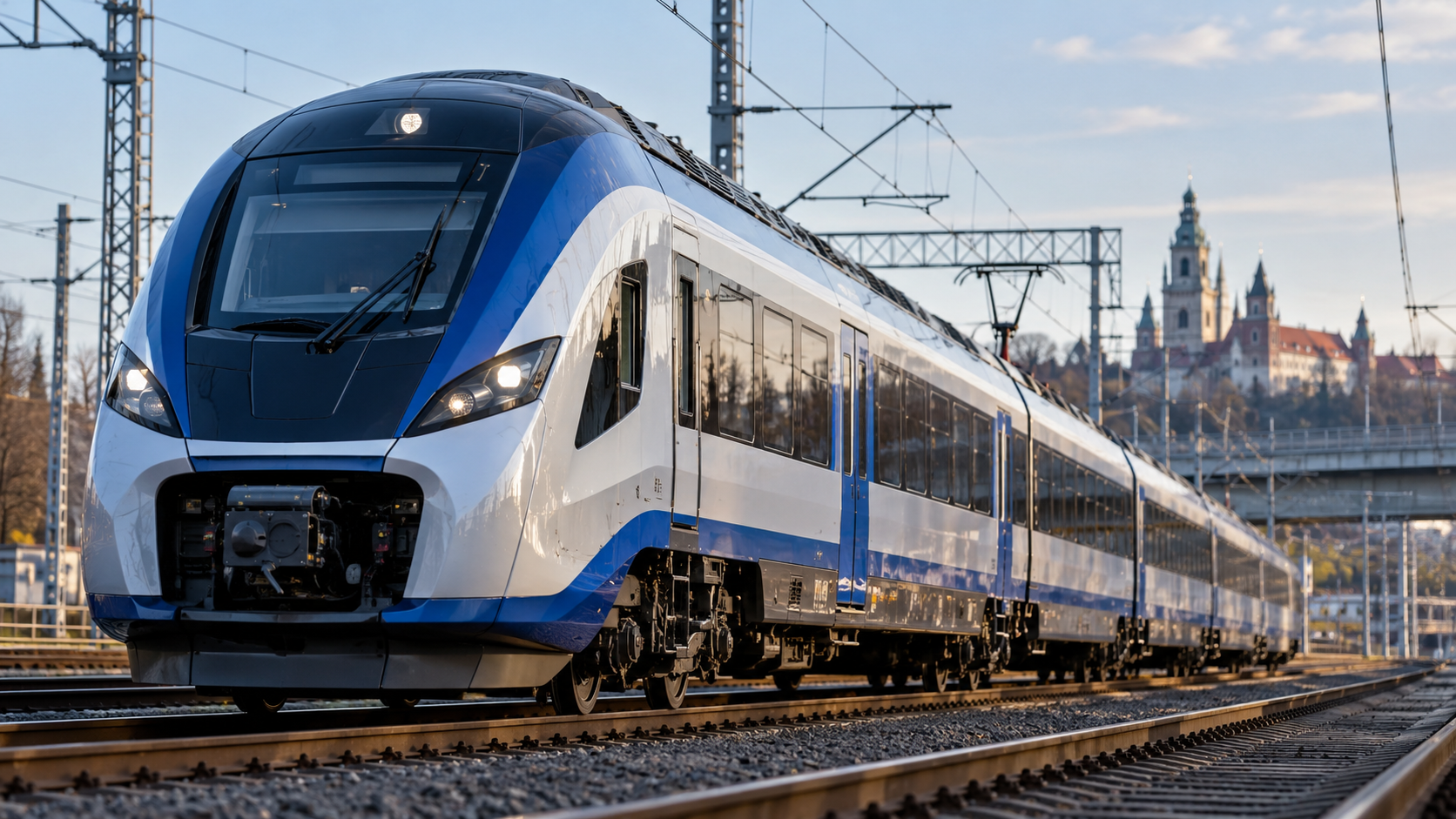
Polish railway manufacturer PESA has signed a cooperation agreement with India’s Jupiter Wagons to explore the joint production of locomotives and passenger trains, technology transfer and the development of hydrogen-powered railway vehicles.
The agreement was signed on Thursday, 22 October 2026, during the Polish-Indian Economic Forum in New Delhi, providing the Bydgoszcz-based manufacturer with a local industrial partner as it seeks to expand beyond its established European markets.
Under the proposed partnership, the companies will explore using Polish railway technology in vehicles manufactured for Indian customers, alongside cooperation on railway components and lower-emission transport.
Indian partner Jupiter Wagons has separately identified opportunities in metro, semi-high-speed and high-speed passenger rolling stock as central areas of interest.
However, the agreement is a non-binding memorandum of understanding (MoU), according to Jupiter Wagons’ formal stock-exchange disclosure dated 23 October.
No manufacturing investment, vehicle order, production volume or delivery timetable has been confirmed.
The partnership therefore represents an initial commercial agreement rather than an announcement that new trains are already being manufactured in India.
Three areas of cooperation agreed
The Polish Development Fund (PFR), PESA’s majority shareholder, confirmed the agreement on 22 October, identifying three principal areas in which the companies intend to work together.
The first concerns the potential establishment of production of locomotives and passenger railway vehicles in India using technology developed by PESA.
Rather than relying entirely on finished vehicles exported from Poland, such cooperation could eventually allow PESA to participate in Indian manufacturing through technology transfer and local industrial partnerships.
The second area covers projects intended to reduce emissions from railway operations, including the development of hydrogen-powered rolling stock.
The third involves the production and supply of railway components, creating potential opportunities across the wider manufacturing and engineering supply chain.
These areas reflect the capabilities of the two partners.
PESA designs, manufactures and maintains railway vehicles, including passenger trains and trams, while Jupiter Wagons has an established position in India’s freight-wagon, railway-components and associated manufacturing markets.
The proposed arrangement could combine Polish vehicle design and engineering expertise with an Indian manufacturer familiar with local industrial requirements and railway customers.
However, neither company has announced a specific manufacturing facility, investment budget or timetable for beginning joint production.
Indian partner confirms non-binding status
The legal status of the agreement is particularly important.
In a regulatory filing submitted to India’s National Stock Exchange and BSE on 23 October, Jupiter Wagons formally identified the agreement as a non-binding memorandum of understanding.
The filing states that the companies intend to explore passenger rolling-stock opportunities associated with India’s metro, semi-high-speed and high-speed railway markets.
The Indian manufacturer also published a separate statement outlining its commercial ambitions.
That announcement describes the MoU as a framework for examining cooperation in developing, manufacturing and deploying passenger railway vehicles for regional, intercity and urban services in India and potentially other markets.
The distinction between the two announcements is useful.
PESA’s Polish announcement emphasises locomotive production, technology transfer, hydrogen-powered rail vehicles and component manufacturing.
Jupiter Wagons’ Indian announcement places particular emphasis on building capabilities in passenger trains for metro and faster intercity services.
These priorities are compatible, but neither announcement establishes that every proposed product category will become a commercial manufacturing programme.
A non-binding MoU generally records an intention to explore cooperation rather than a definitive commitment to purchase equipment, invest a specified amount or deliver vehicles.
Further agreements would be required before individual projects could proceed.
The complete signed MoU has not been made available for independent review, so any specific clauses governing exclusivity, intellectual-property rights, investment contributions or implementation deadlines remain unverified.
India offers a major opportunity for Polish railway technology
For PESA, the attraction of India lies in the potential scale of the country’s railway investment and the demand for different categories of passenger transport.
India is developing urban metro systems, modernising conventional railway services and investing in faster intercity connections.
Its first high-speed railway corridor is also under development.
These programmes create potential demand for passenger rolling stock, components, maintenance services and manufacturing technology.
However, the needs of Indian railway operators differ considerably between urban networks, regional routes and long-distance services.
Metro vehicles, conventional passenger trains and high-speed trainsets involve different technical requirements, operating conditions and procurement processes.
For a foreign manufacturer, gaining access to these markets can require compliance with Indian technical standards, local industrial partnerships and competitive tendering.
Jupiter Wagons could provide relevant local manufacturing knowledge and experience dealing with Indian railway customers.
In its official statement issued following the agreement, the company highlighted its existing capabilities in freight rolling stock, railway components, castings and wheelsets.
Managing Director Vivek Lohia presented the proposed partnership as part of Jupiter Wagons’ strategy to expand beyond its established freight-wagon operations into a broader railway manufacturing business.
For PESA, the opportunity would be to apply its engineering and vehicle-development experience in a market considerably larger than its traditional Central European customer base.
PESA President Krzysztof Zdziarski described India as a potentially important market outside Europe and identified Jupiter Wagons as a partner through which the Polish company hopes to pursue future projects.
These remain commercial ambitions rather than confirmed sales.
Hydrogen technology forms part of the discussions
One of the more technologically significant aspects of the proposed partnership concerns hydrogen-powered railway vehicles.
PESA has developed hydrogen-traction technology as part of its efforts to provide alternatives to conventional diesel-powered railway operations.
Hydrogen fuel-cell systems generate electricity through a chemical reaction involving hydrogen and oxygen, with water as the direct fuel-cell by-product.
Railway applications may offer an alternative on routes where conventional electrification is expensive or technically difficult, although the overall environmental impact depends on how hydrogen is produced, transported and supplied.
PESA and Jupiter Wagons intend to explore opportunities connected with the decarbonisation of rail transport, including hydrogen-powered rolling stock.
However, no particular hydrogen vehicle, demonstration programme or Indian customer has been identified under the newly announced agreement.
There is also no confirmed order for hydrogen locomotives or passenger trains.
Any future commercial project would need to address infrastructure requirements, vehicle certification, operating costs and the availability of appropriate hydrogen supplies.
The hydrogen component should therefore be understood as a potential area of industrial and technological cooperation, not a completed export of Polish hydrogen-train technology.
Jupiter Wagons seeks to expand beyond freight vehicles
Jupiter Wagons is an established Indian railway manufacturer with activities spanning freight wagons, railway components and associated engineering products.
The listed company supplies Indian Railways and other customers and operates manufacturing facilities across several Indian industrial locations.
Its existing capabilities include railway wheels, axles, wheelsets, bogies and other components used in rolling-stock production.
According to the company’s October announcement, it is seeking to develop a more comprehensive railway manufacturing business encompassing both freight and passenger transport.
Cooperation with PESA could provide access to experience in designing and manufacturing passenger vehicles.
PESA, meanwhile, could benefit from Jupiter Wagons’ industrial facilities, component supply capabilities and knowledge of the Indian procurement market.
Such an arrangement could be commercially attractive if the partners are able to agree suitable manufacturing, technology-licensing and customer-delivery arrangements.
But the present MoU does not disclose how future revenues, costs or responsibilities would be divided.
It also does not establish that PESA has sold its intellectual property or transferred ownership of particular designs to Jupiter Wagons.
Technology transfer is a proposed cooperation objective; its final contractual scope has not been confirmed.
PESA continues expanding beyond Poland
The Indian agreement follows other international developments involving PESA during 2026.
The company manufactures railway vehicles at its main operations in Bydgoszcz, northern Poland, and supplies customers in several European markets.
According to PFR’s October announcement, PESA is currently producing vehicles for operators in Romania, Czechia and Germany.
In June, the PESA group completed its acquisition of German tram manufacturer HeiterBlick.
The transaction expanded its presence in the German railway manufacturing market.
In July, PESA also entered into a cooperation agreement with Hitachi Rail, covering areas including advanced manufacturing technology and potential joint railway projects.
That arrangement includes the proposed transfer of expertise involving aluminium welding and double-deck vehicle structures to PESA’s Bydgoszcz facilities.
PESA and Hitachi Rail are also participating in a procurement process involving very-high-speed vehicles for Polish national railway operator PKP Intercity.
The new Indian partnership represents another potential direction for PESA’s international expansion, although its commercial maturity differs from completed acquisitions and existing rolling-stock orders.
The company remains closely connected to the Polish state through its ownership structure.
Polski Fundusz Rozwoju, the state-backed Polish Development Fund, holds approximately 99.78% of PESA’s shares, according to PFR’s latest company information.
PFR said the agreement reflected its ambition to support Polish industrial businesses establishing a longer-term presence in international markets.
Agreement signed during Polish government visit
The cooperation agreement was concluded during a broader Polish economic mission to India accompanying Prime Minister Donald Tusk’s official visit from 21 to 23 October.
The Polish-Indian Economic Forum brought together representatives of businesses and institutions involved in international trade, investment and industrial cooperation.
The Polish delegation included representatives of PFR, the Polish Investment and Trade Agency (PAIH), state development bank BGK and export-credit insurer KUKE.
These institutions participate in Poland’s wider efforts to support companies entering international markets.
The visit also formed part of the countries’ broader economic relationship.
In their joint statement following the prime ministers’ discussions, Poland and India emphasised stronger trade and investment relations and opportunities for businesses operating across the two economies.
However, the PESA–Jupiter Wagons agreement remains a separate commercial arrangement between the companies.
The government visit provides context for its signing, rather than confirmation that public financing, Indian procurement contracts or regulatory approvals have been secured.
First manufacturing project remains to be established
The immediate business significance of the announcement is that PESA has identified a formal Indian partner with established railway manufacturing capabilities.
The agreement creates a basis for exploring joint projects involving passenger vehicles, locomotives, components and lower-emission technologies.
If those discussions lead to commercial agreements, they could provide opportunities for Polish engineering expertise to be used in India’s railway industry while allowing Jupiter Wagons to expand its passenger-rolling-stock capabilities.
But several important questions remain unanswered.
Neither company has disclosed an investment value, the location of any proposed joint production facility, the number of vehicles that might be manufactured or the terms of any technology-licensing arrangement.
No Indian railway operator has been confirmed as a customer under the partnership, and no delivery date has been announced.
The next substantial development would be a definitive agreement covering a particular manufacturing or supply programme, followed by confirmed investment commitments or customer orders.
For now, the non-binding MoU marks an important step in PESA’s pursuit of opportunities in India, but the commercial scale of that expansion remains to be determined.