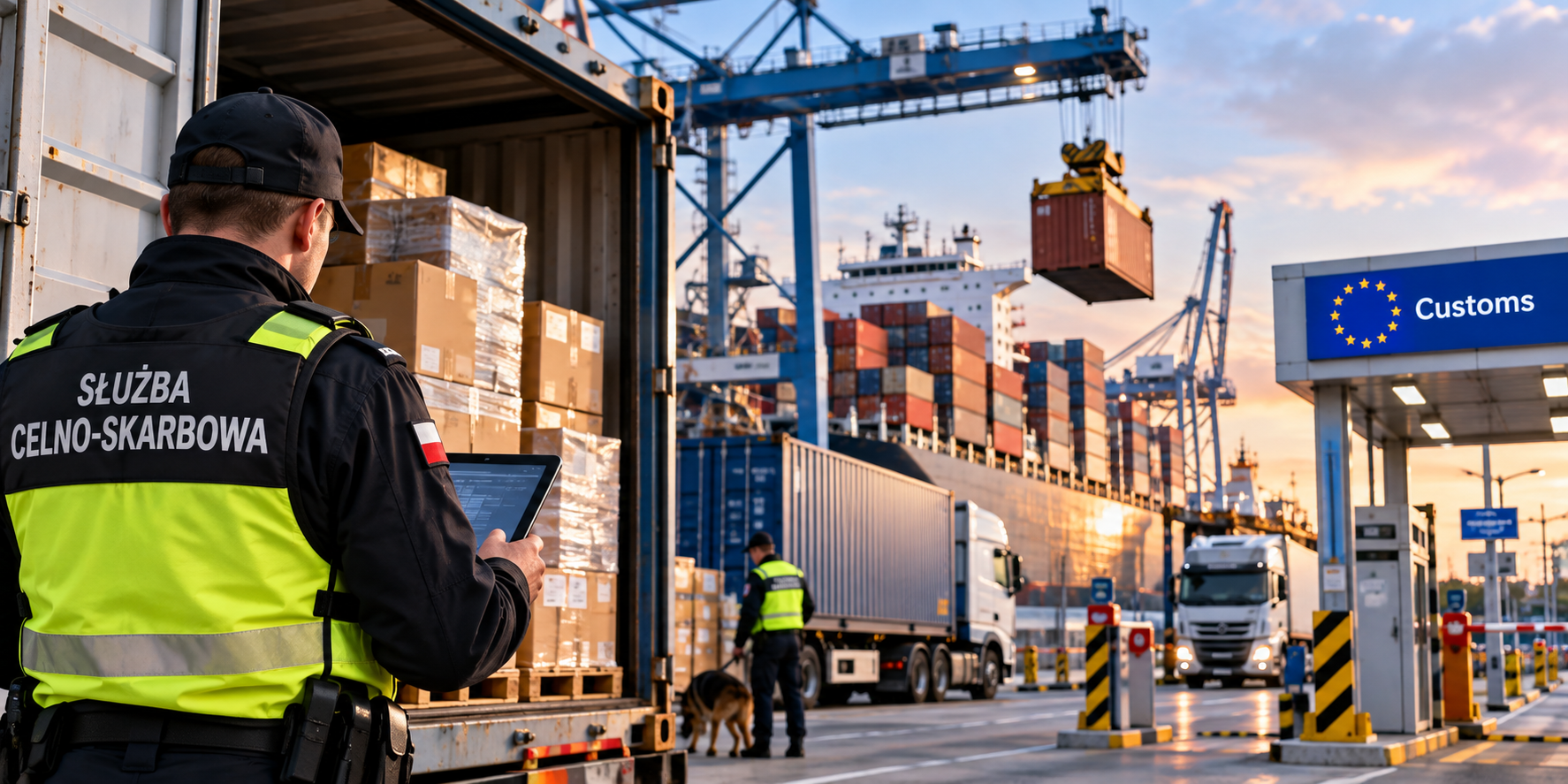
The European Union’s new Customs Code has formally entered into force, beginning a multi-year overhaul of the rules and digital systems used by Polish companies trading across the EU’s external border.
Regulation (EU) 2026/2108 was published in the EU Official Journal on 19 September and entered into force on 20 September 2026. It replaces the existing Union Customs Code, creates a new European Union Customs Authority and establishes the legal framework for a central EU Customs Data Hub.
For businesses, however, 20 September was the start of implementation rather than a wholesale switch to the new regime.
Most of the regulation will apply from 21 September 2027. Other elements, particularly those affecting e-commerce and the Customs Data Hub, will be phased in later, with the transition extending into the 2030s.
Poland’s National Revenue Administration, KAS, describes the reform as the largest change to EU customs rules in decades.
What changed on 20 September?
Only selected parts of the new Customs Code apply immediately.
These include provisions needed to begin establishing the new institutional and digital architecture, including the EU Customs Authority, work on the EU Customs Data Hub and powers allowing the European Commission to adopt the delegated and implementing legislation needed for the new system.
That distinction matters for importers and exporters.
Existing customs processes have not disappeared, and businesses should not treat 20 September as the date on which current declarations, customs authorisations or national systems were replaced.
The general application date for most provisions is 21 September 2027.
A single EU Customs Data Hub will eventually replace national systems
One of the reform’s largest structural changes is the creation of the EU Customs Data Hub.
The European Commission describes it as a single digital interface through which businesses will ultimately provide customs and product information. The Hub will combine import and export data and give customs authorities across the EU shared, real-time information about goods and supply chains.
The goal is to move away from a system built around separate declarations and numerous national IT platforms towards a more centralised, data-led customs system.
The transition will be gradual.
E-commerce operators will be required to use the Data Hub from 1 July 2028.
Other economic operators will be able to start using it voluntarily from 1 March 2031.
Use of the Data Hub is scheduled to become mandatory for all relevant traders from 1 March 2034.
For Polish companies, that means the practical preparation period is considerably longer than the initial 12-month transition attached to the general provisions of the Code.
Businesses with substantial import or export operations will eventually need their customs, ERP, product-data and logistics systems to interact with a different EU-wide information architecture.
New EU Customs Authority created
The regulation also creates the European Union Customs Authority, or EUCA.
The new agency will be based in Lille, France, and is intended to support national customs administrations through EU-level risk analysis, information sharing and coordination.
It will also manage the EU Customs Data Hub.
National customs administrations, including Poland’s KAS, will continue to perform customs functions, but the reform creates a stronger central EU coordination layer.
The Commission says preparatory work on establishing the Authority has already begun, with some activities expected to start during 2027.
E-commerce businesses face changes much sooner
For companies involved in online sales from outside the EU to customers in Poland, some of the most immediate changes arrive considerably earlier than the full Data Hub.
The new Code creates a Union handling fee for goods sold through distance sales and released for free circulation in the EU.
Article 20 requires customs authorities to collect a fixed fee per item to reflect the costs of customs processing, including data checks, risk analysis, infrastructure and controls. The fee is separate from customs duty and is non-refundable.
On 21 September, the European Commission adopted delegated act C(2026) 6694, setting the fee at €2 per item.
As of 27 September, however, the €2 fee is not yet being collected.
The delegated act remains subject to the EU scrutiny procedure. If it completes that process without objection, it must be published before the charge can begin applying. Under the Customs Code, collection starts ten days after the delegated act enters into force.
The Commission currently says the Union handling fee will be introduced by 1 November 2026.
Businesses should therefore prepare for the €2 figure but should not yet treat it as a charge already in operation.
The €2 fee is different from the existing €3 customs duty
E-commerce businesses should also distinguish the new handling fee from another EU measure already in force.
Since 1 July 2026, the EU has applied a temporary €3 customs duty per item to qualifying distance-sale goods imported in consignments with an intrinsic value of no more than €150.
That measure replaced the previous customs-duty exemption for low-value imports. It is scheduled to apply until 1 July 2028.
The €2 handling fee serves a different purpose: it is intended to meet customs authorities’ processing and supervision costs.
Depending on the transaction, a distance-sale import could therefore face both customs duty and the new handling charge, as well as any applicable import VAT.
Companies should avoid describing the two measures as a single €5 customs tax because they arise under different rules and do not have identical scopes.
Online sellers and platforms will take greater responsibility
The new Customs Code also changes who carries responsibility for many e-commerce imports.
Under the new framework, suppliers and online platforms facilitating qualifying distance sales will increasingly be treated as the importer for distance sales, rather than leaving customs responsibility principally with the final consumer.
The Commission says those businesses will become responsible for customs information, financial obligations and compliance requirements relating to products they sell into the EU.
The major Data Hub obligations for distance sales are scheduled to apply from 1 July 2028.
For marketplaces, online sellers, fulfilment providers and customs intermediaries serving Polish consumers, that makes customs data quality increasingly important.
Product classification, origin, seller information and other customs data will need to move accurately through commercial and logistics systems before goods reach the EU border.
What this means for UK–Poland trade
The reform is also directly relevant to companies trading between Great Britain and Poland.
For customs purposes, goods moving from Great Britain into Poland enter the EU from a non-EU country and are therefore subject to EU customs procedures and formalities.
The EU–UK Trade and Cooperation Agreement allows qualifying UK-origin goods to benefit from zero tariffs and zero quotas, but businesses must satisfy the applicable rules of origin and hold the necessary evidence to claim preferential treatment.
The new Customs Code does not remove those origin requirements.
Instead, it changes the wider customs framework through which information, controls and obligations will increasingly be managed.
A UK manufacturer selling wholesale goods to a Polish importer, for example, may continue to qualify for zero customs duty under the Trade and Cooperation Agreement if its goods meet the origin rules, while still being affected over time by the new EU customs data architecture.
UK e-commerce sellers shipping directly to Polish consumers face an additional layer because the new distance-sales rules and handling fee concern goods entering the EU from outside the bloc.
Businesses dealing with Northern Ireland should assess their position separately because different customs arrangements apply there.
What Polish businesses should do now
For most conventional Polish importers and exporters, there is no need to replace existing customs systems immediately.
The more useful approach is to map where the reform is likely to affect operations over the next several years.
Companies should identify which customs declarations, authorisations and data flows they currently rely on; review the quality and ownership of product, classification and origin data; and establish which suppliers, customs agents, platforms and logistics providers currently provide information on their behalf.
Groups trading with the UK or other non-EU markets should also review how customs information moves between overseas suppliers and Polish entities.
E-commerce businesses have the shortest timetable. Sellers and platforms importing goods directly for EU consumers should already be checking how the temporary €3 duty is being handled and preparing systems for the proposed €2 Union handling fee once its legal start date is confirmed.
The Data Hub itself is a longer-term project, but businesses with complex customs operations may need several years to adapt IT and supply-chain systems before mandatory use reaches them.
KAS to explain timetable on 30 September
Poland’s customs administration is holding an open online webinar for businesses on 30 September 2026 from 11:00 to 12:00.
KAS says the session will cover the implementation timetable for the new Customs Code and the Union handling fee for distance-sale goods. No advance registration is required.
For Polish companies, the immediate message is therefore not that the existing customs system has been replaced overnight.
The new legal framework is in force, but the operational transition has only begun.
The most important deadlines currently stretch from the expected introduction of the e-commerce handling fee in late 2026, through general application of the new Code in September 2027 and mandatory Data Hub use for e-commerce in July 2028, to the eventual full transition to the central system in 2034.