Poland has launched a PLN 792 million (about $206 million/€181 million) EU-backed financing programme for companies investing in digitalisation, automation, robotics and green transformation.
The Polish Agency for Enterprise Development, or PARP, has initially made PLN 500 million (about $130 million/€114 million) available through five financing partners. The money forms part of Poland’s European Funds for a Modern Economy programme, known by its Polish acronym FENG.
Businesses will be able to borrow between PLN 2.5 million and PLN 15 million — approximately $650,000 to $3.9 million, or €570,000 to €3.4 million — for eligible investments. PARP lists a maximum repayment period of 15 years and a capital-repayment grace period of up to 24 months.
The programme has been launched, but formal loan applications are not yet open. Companies can already contact the selected financing partners to discuss projects and the application process. The government says applications should begin around 30 days after 25 September, while PARP currently lists October 2026 as the start of intake.
Who can use the fund?
The programme covers micro, small, medium-sized and large enterprises implementing investments in Poland.
That makes it broader than many EU-backed business schemes that are restricted to SMEs. PARP’s published eligibility criteria cover businesses across Poland and do not state a separate restriction based on whether an eligible Polish enterprise is domestically or foreign owned. Individual companies will nevertheless need to satisfy the relevant financing partner’s eligibility, credit and state-aid requirements.
FENG is Poland’s EU funding programme for 2021–2027 focused on areas including innovation, competitiveness and business transformation.
What can businesses finance?
Companies can finance digital transformation, green transformation or combine both components within one investment.
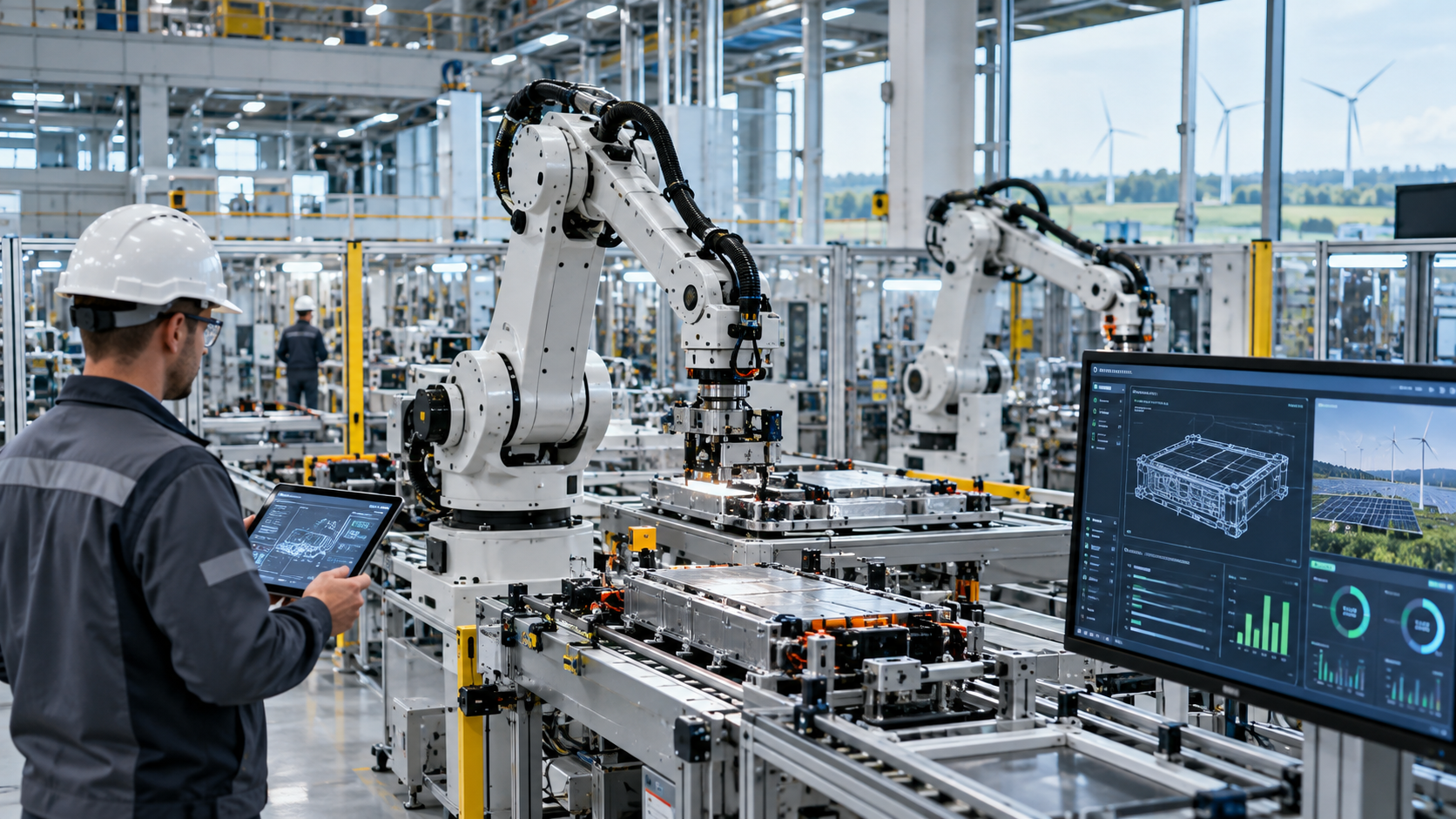
For digital projects, PARP lists investments including ERP, MES and SCADA production and logistics systems; artificial intelligence; Internet of Things technology; cloud computing; predictive analytics; CAD and CAM systems; digital twins; automated data collection; industrial robots; automated manufacturing centres; autonomous guided vehicles; and digital B2B or B2C services.
The green component includes investments designed to reduce the consumption of raw materials and other resources, limit waste and emissions, improve circular use of materials and introduce more sustainable production models.
Examples include production-line changes that reduce waste or allow materials to be reused, recycling and material-recovery machinery, technologies reducing water consumption, process-water recovery, ecodesign and digital systems for measuring product life cycles or carbon footprints.
Working-capital expenditure directly connected with an investment can account for up to 25% of the loan. Digital and green components can also be combined in a single project.
One distinction is important for businesses considering energy projects. PARP says the green component is intended for sustainable-development and circular-economy investments and excludes support aimed solely at increasing a company’s energy efficiency. Broader qualifying projects can nevertheless include measures that reduce energy use as part of the transformation.
Loans of up to PLN 15m
The minimum loan is PLN 2.5 million, or about $650,000/€570,000, while the maximum is PLN 15 million, or roughly $3.9 million/€3.4 million.
PARP lists the required own contribution at 0%, a maximum financing period of 15 years and a possible capital-repayment grace period of up to 24 months.
The headline preferential interest rate is 0.5% a year.
However, companies should not assume that the 0.5% rate will apply automatically in every case. The government says preferential financing is linked to applicable state-aid rules, including de minimis aid. Where an investment cannot receive financing under de minimis rules, market-based financing may instead be available, currently at an indicated rate of around 5.3% a year.
Under the EU’s general de minimis regulation, the total de minimis aid granted by a member state to a single undertaking cannot exceed €300,000 over a three-year period. EU rules can also treat linked companies as a single undertaking when determining that limit.
Companies that have already received substantial de minimis support should therefore check their remaining allowance and the applicable financing route with the partner handling their application.
Conditional grant can reduce the loan principal
The programme differs from an ordinary preferential business loan because qualifying companies can also receive a conditional grant used to repay part of the loan principal after completing the investment.
According to PARP’s programme rules, the level depends on the investment type and, in some cases, its location.
Projects located in one of 139 designated medium-sized cities losing socio-economic functions, or in municipalities threatened by permanent marginalisation, can qualify for a conditional grant equal to 5% of the loan principal.
Projects containing a circular-economy, or GOZ, component can qualify for 10%, increasing to 15% for qualifying projects in the designated areas.
For digital-transformation projects, the 5% conditional grant is available where the investment is located in the designated areas.
Where one loan combines both components, PARP says the maximum conditional grant is 15%.
For a PLN 15 million loan, 15% would represent PLN 2.25 million — approximately $590,000 or €510,000 — although the actual grant depends on the programme conditions and qualifying investment.
Five financing partners are already in place
PARP manages the fund but does not issue the individual loans itself. Financing will be distributed through selected financial partners.
The first five are Biłgorajska Agencja Rozwoju Regionalnego; a consortium of Stowarzyszenie Samorządowe Centrum Przedsiębiorczości i Rozwoju and Fundacja Rozwoju Regionu Rabka; a consortium of Fundacja Kaliski Inkubator Przedsiębiorczości and Agencja Rozwoju Regionalnego AGROREG; Podlaska Fundacja Rozwoju Regionalnego; and ING Bank Śląski.
A sixth financing partner is expected to join later.
The initial PLN 500 million pool is expected to finance around 200 investments. Businesses can already approach the five partners for information and discuss an application before formal intake begins.
What businesses should check before applying
Companies considering the programme should first establish whether their planned expenditure genuinely constitutes digital transformation, a qualifying green or circular-economy investment, or a combination of the two.
They should also examine their existing state-aid position, particularly previous de minimis aid, and determine whether the investment location could increase the conditional-grant element.
The published PARP timetable currently shows applications beginning in October 2026 and continuing until March 2029, with applications to be handled by the financing partners rather than directly by PARP.
For businesses preparing sizeable automation, robotics, digital infrastructure or resource-efficiency investments in Poland, the combination of long-term financing, a preferential interest-rate route and the possibility of partial principal repayment makes the programme worth examining before committing to conventional commercial financing.