Polish mining group KGHM has formally started construction of a $725 million expansion of the Sierra Gorda copper mine in Chile, moving one of its largest international investment projects from approval into physical development.
A foundation-stone ceremony on 2 October marked the start of work on a fourth grinding line at the mine, which KGHM owns jointly with Australian mining group South32.
Under the project, annual ore-processing capacity is expected to increase from around 48 million tonnes to approximately 60 million tonnes, while copper production is targeted to rise by roughly 20%.
KGHM said the expansion is now under way, with construction scheduled for completion by the end of 2029 and full production capacity expected in the second half of 2030.
The construction milestone advances a project that the Sierra Gorda partners approved in July following completion of a feasibility study.
$725m is the value of the whole project
The headline investment figure needs an important qualification.
The approximately $725 million capital cost is stated on a 100% Sierra Gorda basis.
KGHM owns 55% of Sierra Gorda, while South32 holds the remaining 45%.
That does not mean KGHM will simply contribute 55% of the $725 million directly from its Polish balance sheet.
The partners say the development will instead be financed through Sierra Gorda’s operating cash flow and available debt facilities.
South32’s final investment approval announcement confirmed that the estimated capital expenditure covers the entire joint venture and runs across the development period to commissioning.
For KGHM, the investment nevertheless represents a substantial expansion of its most important foreign mining asset.
A fourth processing line is at the centre of the project
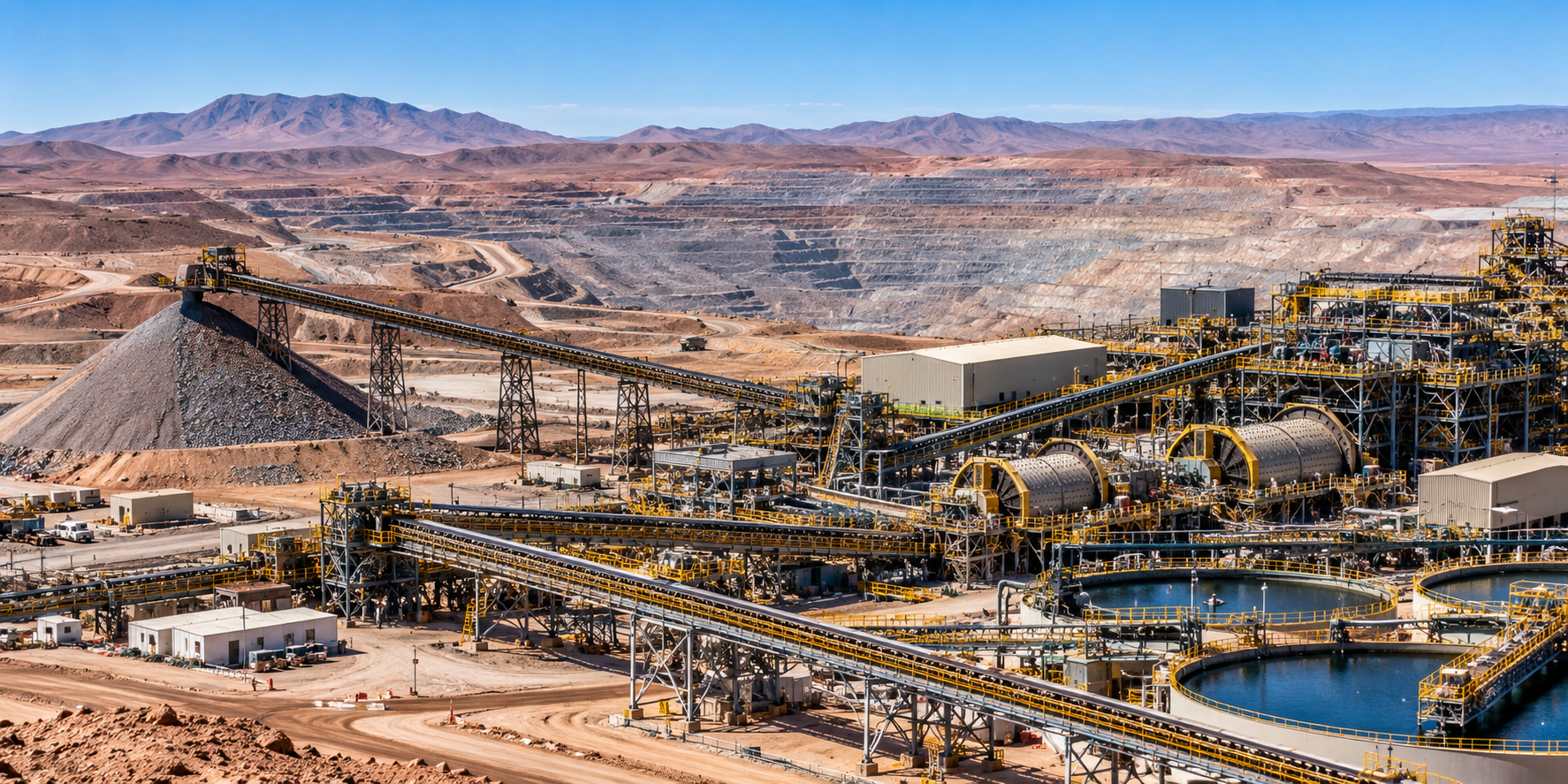
Sierra Gorda is a large open-pit copper and molybdenum mine in Chile’s Antofagasta region, around 60 kilometres south-west of Calama in the Atacama Desert.
The expansion centres on a fourth grinding line designed to increase the amount of ore that the processing plant can handle.
The project includes:
- a new jaw crusher;
- a high-pressure grinding roll, or HPGR, mill;
- a ball mill;
- an additional flotation line; and
- the associated processing infrastructure.
The mine currently processes around 48 million tonnes of ore annually.
Once the expansion is operating at full capacity, that figure is expected to reach approximately 60 million tonnes a year, an increase of about 25%.
KGHM expects the additional throughput and improvements in operating efficiency to translate into approximately 20% higher annual copper production.
South32’s project documentation provides another way of expressing the scale of the increase.
It expects Sierra Gorda’s average annual payable production after completion to reach around 195,000 tonnes of copper, alongside approximately 6,000 tonnes of molybdenum, 58,000 ounces of gold and 1.7 million ounces of silver, all measured on a 100% ownership basis.
What “payable copper” means
Mining companies frequently report payable copper rather than simply the total amount of copper contained in mined ore.
The term refers broadly to the quantity of metal for which the producer receives commercial payment after applying the relevant processing, recovery and contractual deductions.
It therefore provides a more commercially useful production measure than simply stating the theoretical metal contained in the ore.
In calendar year 2025, Sierra Gorda produced approximately 160,000 tonnes of payable copper on a 100% basis, according to KGHM.
KGHM’s attributable 55% share amounted to 86,800 tonnes.
The planned expansion would therefore materially increase the contribution Sierra Gorda makes to the Polish group’s international copper production.
KGHM’s biggest overseas investment
Sierra Gorda occupies an unusual position in KGHM’s portfolio.
The company describes the Chilean mine as both its largest foreign investment to date and its key international asset.
KGHM remains primarily associated with its copper mines and metallurgical operations in south-west Poland, but the group also operates internationally across North and South America.
Expanding Sierra Gorda therefore supports KGHM’s strategy of increasing the role of overseas assets in its overall production base.
The mine already benefits from substantial existing infrastructure.
KGHM says Sierra Gorda uses seawater delivered by pipeline from the Mejillones area, while its electricity supply is sourced entirely from renewable energy.
Using those existing water and power systems is one reason the fourth grinding line can be developed as a brownfield expansion rather than as an entirely new mining project.
South32 expects the higher throughput to reduce average operating unit costs by roughly 10% once the expansion reaches normal production.
Copper demand is becoming increasingly strategic
The project also comes as copper becomes increasingly important to the global expansion of electricity infrastructure.
Copper is widely used in power grids, electrical equipment, renewable-energy systems, electric vehicles and industrial electrification because of its high electrical conductivity.
The International Energy Agency’s 2026 critical-minerals outlook projects copper to record the largest absolute demand increase among the major energy-transition minerals it tracks, adding around 7 million tonnes of demand by 2040 under its stated-policies scenario.
The IEA identifies electricity networks and next-generation technologies as major drivers.
That longer-term demand outlook is one reason large producers are investing in extending and expanding existing copper assets even when major greenfield mining projects can take many years to develop.
For KGHM, Sierra Gorda provides a way to increase output from an operating mine where much of the infrastructure is already in place.
Expansion was approved in July
The $725 million programme itself is not new.
The Sierra Gorda joint venture approved the investment at the end of June, and KGHM announced the final investment decision on 1 July.
At that point, the fourth grinding line remained an approved capital project.
The new development on 2 October is that the partners have formally moved into the construction stage, marked by the foundation-stone ceremony at the mine.
The distinction matters for investors following the project because the principal question now moves from whether KGHM and South32 will commit the capital to whether construction proceeds on timetable and budget.
Production ramp-up runs into 2030
The construction programme is scheduled to continue until the end of 2029.
KGHM expects Sierra Gorda to reach full production capacity in the second half of 2030.
South32 expresses the timetable using its Australian financial year, with first production expected around the middle of FY2030 and full production rates during FY2031.
The two descriptions are broadly consistent but use different reporting calendars.
Until the additional plant is commissioned and ramped up, the expected production gains remain forecasts rather than realised output.
Exploration could extend Sierra Gorda further
KGHM is also investigating whether the mine’s future could extend beyond the currently planned expansion.
Exploration is continuing around Catabela Northeast, an area immediately adjacent to Sierra Gorda’s existing operations.
Geochemical surveys, geophysical work and core drilling have identified continuing copper-molybdenum mineralisation that remains open at depth.
KGHM says preliminary work suggests the area could contain several billion tonnes of mineralised ore, although further exploration is still needed to establish the size, quality and economic viability of the deposit.
South32’s latest reporting likewise identifies Catabela Northeast as a potential source of further mine-life extension.
That distinction is important: exploration potential is not the same as a proven reserve or an approved mining project.
KGHM says that if the geological potential is confirmed, Catabela Northeast could eventually extend Sierra Gorda’s operating life and, in an optimal scenario, support another mining development in the area.
Existing reserve life has already increased
Separate from Catabela Northeast, South32 reported in its 2026 results that infill drilling at Sierra Gorda had supported a 61% increase in the mine’s ore reserve estimate to approximately 1.1 billion tonnes, extending its reserve life by around five years to 2045.
That makes investment in additional processing capacity more commercially significant because the partners have a larger identified reserve base over which to use the expanded plant.
Further success at Catabela Northeast could add another layer to that long-term development potential.
A major test for KGHM’s international strategy
For KGHM, the next three years will turn Sierra Gorda from an approved expansion plan into a significant construction project.
The group expects the fourth grinding line to raise output, lower unit production costs and increase the weight of its international operations within the wider KGHM portfolio.
The immediate milestone is no longer investment approval.
It is execution.
Construction is now under way, with the end of 2029 set as the target for completing the expanded plant and the second half of 2030 as the point at which the mine is expected to reach its new full production capacity.