
Poland’s payroll system includes several mandatory social-insurance contributions administered by the Social Insurance Institution, Zakład Ubezpieczeń Społecznych (ZUS). For employees and employers, the most important point is that the cost is shared rather than deducted entirely from one side.
The main categories are old-age pension insurance, disability pension insurance, sickness insurance and accident insurance. Each has its own rate and, in most cases, its own division between employer and employee.
For English-speaking employees, this helps explain a basic feature of Polish payroll: the salary stated in an employment contract is not the same as take-home pay, while the employer’s total employment cost is usually higher than the employee’s gross salary.
Old-age pension insurance
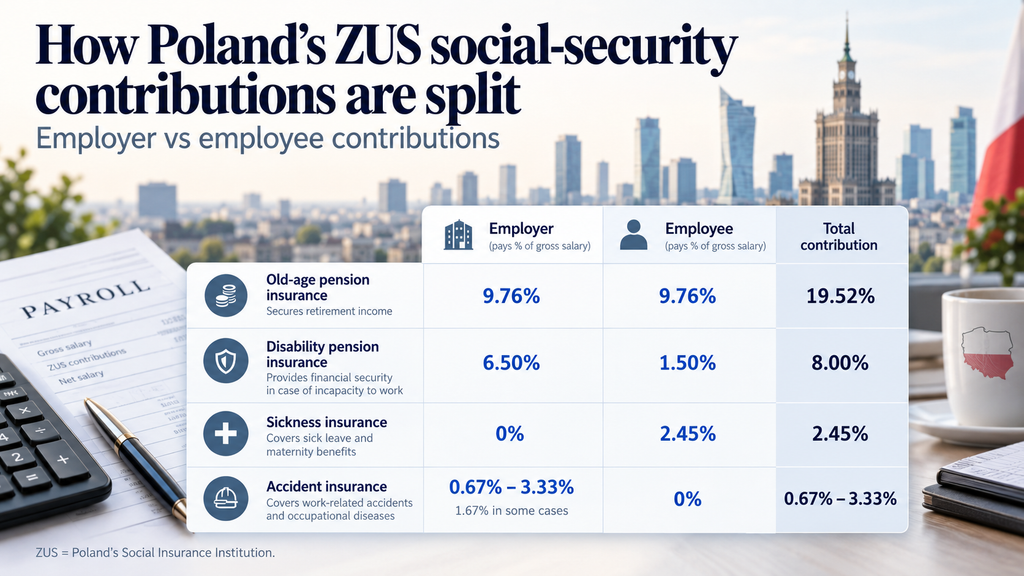
Old-age pension insurance is charged at a total rate of 19.52 per cent of the assessment base.
The cost is divided equally between the employer and the insured employee. The employer pays 9.76 per cent and the employee contributes another 9.76 per cent.
This is one of the clearest examples of Poland’s shared contribution structure. The employee portion reduces the amount remaining from gross salary before other deductions, while the employer bears an additional contribution of the same percentage.
Disability pension insurance
Disability pension insurance has a total contribution rate of 8 per cent.
The employer pays the larger share at 6.5 per cent of the assessment base, while the insured employee contributes 1.5 per cent.
This means the cost split is different from old-age pension insurance. The two sides do not always contribute equally across all parts of the ZUS system.
Sickness insurance
Sickness insurance is charged at 2.45 per cent of the assessment base.
For an employee covered by the contribution, this amount is paid entirely by the insured person rather than being shared with the employer.
The sickness contribution therefore forms part of the deductions that reduce gross pay from the employee’s perspective.
Accident insurance
Accident insurance works differently because there is no single universal percentage for every employer.
ZUS states that the rate can range from 0.67 per cent to 3.33 per cent of the assessment base, depending on the applicable risk category. The contribution is paid by the employer rather than the employee.
A 1.67 per cent rate applies in some cases under the rules described in ZUS guidance.
This variable structure means two employers paying the same gross salary can face different accident-insurance costs if they fall into different risk categories.
What the contribution split means in practice
The ZUS contribution structure is one reason gross salary should not be treated as either the employee’s final income or the employer’s full payroll cost.
Part of the employee’s gross salary is used to fund their share of social insurance. At the same time, the employer adds its own contributions on top of the gross salary.
The exact difference between gross pay, take-home pay and total employer cost depends on more than the four insurance categories described here. Other payroll obligations and tax rules also affect the final figures, so the contribution rates should not be read as a complete payroll calculation.
They do, however, provide a useful framework for understanding where part of the employment cost goes.
For employers comparing labour costs across jurisdictions, the distinction is especially important. A salary benchmark based only on contractual gross pay may not reflect the additional ZUS obligations borne by the company.
For employees relocating to Poland, the same structure helps explain why a gross salary offer cannot be converted directly into net monthly income by subtracting income tax alone.
Employee and employer shares are not identical
The contribution structure can be summarised simply.
Old-age pension insurance is shared equally. Disability insurance is weighted more heavily towards the employer. Sickness insurance is paid by the insured employee, while accident insurance is paid by the employer and varies according to risk.
These categories form part of Poland’s wider social-security system and fund different types of protection and benefits.
The percentage rates can be adjusted over time, so current ZUS guidance remains the appropriate reference when calculating payroll. The broader structure — with some contributions shared and others allocated entirely to one side — is nevertheless an established feature of Polish employment costs.
For founders, finance teams and international managers, that distinction is often more useful than looking at one headline contribution percentage.
A company budgeting for a new employee needs to consider employer-side contributions in addition to the agreed gross salary. An employee comparing job offers, meanwhile, needs to account for the contributions deducted from their side before arriving at take-home pay.
Understanding who pays each contribution is therefore a basic part of reading a Polish salary package correctly.