Poland is pushing for a bigger role for domestic companies in the contract to build its first nuclear power station as Warsaw tries to ensure one of the country’s largest infrastructure investments generates industrial work inside Poland as well as importing US reactor technology.
Energy Minister Miłosz Motyka said on 5 October that the government considers completing negotiations by the end of 2026 realistic, but stressed that the final terms need to be advantageous to Polish industry.
The agreement under negotiation is the Engineering, Procurement and Construction contract, or EPC, between state-owned developer Polskie Elektrownie Jądrowe and the Westinghouse–Bechtel consortium.
The parties have already agreed the main commercial and legal terms of the EPC contract. That milestone, announced on 23 September, established a framework for negotiating the remaining detailed contractual provisions and annexes before a planned final agreement.
Motyka’s latest comments make clear that Poland is treating domestic participation as part of those commercial negotiations rather than simply accepting the role of purchaser of US nuclear technology.
Poland wants more than imported reactor technology
The first plant will use three Westinghouse AP1000 reactors at Lubiatowo-Kopalino in the municipality of Choczewo on Poland’s Baltic coast.
Westinghouse is supplying the reactor technology, while Bechtel is the principal engineering and construction partner.
Polskie Elektrownie Jądrowe, or PEJ, is the state-owned investor responsible for delivering the project.
Motyka told Money.pl that the government does not want Poland to be only a recipient of the technology but also to participate in delivering the project and developing the wider nuclear supply chain.
He also said Polish law had been agreed as the governing law for the contract and identified the involvement of Polish companies in supplying components as another important element.
The commercial details of the negotiations remain confidential.
That means there is not yet a published percentage establishing exactly how much of the final EPC contract must go to Polish suppliers.
What the EPC contract would cover
An EPC contract brings together three central functions of a major infrastructure project: engineering, procurement and construction.
For Poland’s nuclear programme, it will define much of the commercial relationship between PEJ and the Westinghouse–Bechtel consortium for delivery of the plant.
It is therefore much broader than the preliminary engineering agreements that have allowed design work and site preparation to continue while the main contract is negotiated.
At the end of 2025, PEJ and the consortium extended their Engineering Development Agreement, or EDA.
That agreement covers continuing engineering and design work, including the nuclear island, turbine island and balance-of-plant systems, alongside geological investigations and preparation for equipment with long manufacturing lead times.
PEJ explicitly described the EDA extension as a bridge allowing work to continue while the EPC contract was negotiated.
The contract Poland is now targeting for completion by year-end is therefore the much more significant long-term construction agreement.
Main commercial terms have already been agreed
Negotiations have moved beyond their earliest stage.
On 23 September, PEJ, Westinghouse and Bechtel agreed the EPC contract’s principal commercial and legal terms.
Westinghouse said that agreement created the framework for negotiations on the remaining detailed provisions and contract exhibits, with the parties targeting completion by the end of 2026.
Motyka’s comments on 5 October indicate that the government still sees that timetable as achievable.
But he linked signature to the quality of the final arrangements for Polish industry.
That makes local content one of the economic issues surrounding the final negotiations, alongside the cost, risk allocation and legal structure of what Motyka described as a particularly large and complicated agreement.
Polish companies are already working on the project
Domestic participation is not starting with the future EPC contract.
Polish companies have already secured work during the preparation phase.
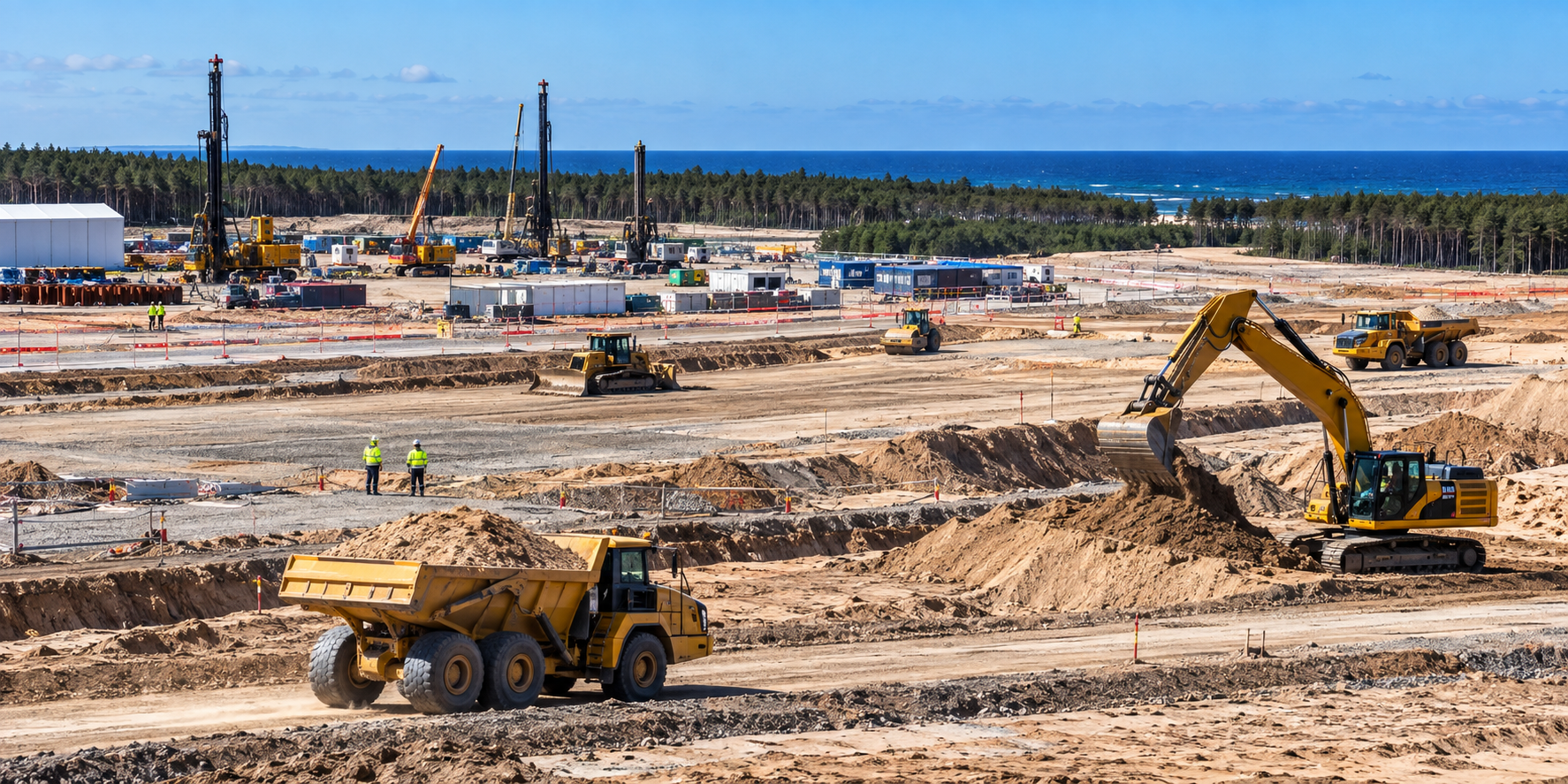
In August, PEJ transferred management of the future construction site to Bechtel as major earthworks began.
Polish construction group Budimex was selected to carry out the principal earthworks, including levelling the site, drainage infrastructure, temporary roads and preparation of technical and logistics areas.
The Energy Ministry said when those works began that Bechtel had already signed five agreements with Polish contractors during the preceding months.
Those included cooperation with Pomeranian construction company DORACO on facilities supporting geological and geotechnical investigations and an agreement with Unihouse to build accommodation for around 1,000 workers.
More recently, Bechtel awarded Polimex Mostostal a contract for two large module-assembly buildings connected with the AP1000 project.
These early awards demonstrate the type of civil-engineering, construction and support work that Polish businesses can capture before the main reactor construction reaches full scale.
The bigger prize is the nuclear supply chain
The government’s ambition goes beyond earthworks and temporary buildings.
The commercially more significant question is how deeply Polish manufacturers, engineering groups and specialist contractors can enter the supply chain for the actual nuclear plant.
That requires capabilities and certifications that are considerably more demanding than those associated with conventional construction projects.
PEJ and the US consortium have been working with Polish businesses on nuclear-industry qualification, procurement planning and the standards needed to bid for specialist work.
At a PEJ supplier event in March, the company said the project had entered advanced design and preparatory work while procurement packages were being presented to Polish businesses so they could plan investment, training and production capacity.
The government has also been funding wider industry preparation. The Energy Ministry said earlier this year that 113 companies took part in specialist nuclear workshops during 2025 and nearly 1,500 specialists had developed nuclear-sector competencies between 2022 and 2025.
For Polish industry, winning ordinary construction packages is therefore only one layer of the opportunity.
Becoming qualified to manufacture or service nuclear-grade components could allow companies to participate in future AP1000 projects elsewhere as well.
No fixed local-content percentage has been announced
The term local content can cover very different kinds of economic participation.
It may include Polish labour, construction work, locally produced components, engineering services, logistics, maintenance and specialist manufacturing.
The government has repeatedly said it wants to maximise that contribution, but there is currently no publicly confirmed final percentage for Polish content in the complete nuclear project.
PEJ has previously discussed issues including how local content should be defined, how work packages should be structured and what certification Polish companies require.
The company has also described itself as an active investor that intends to supervise the consortium’s efforts to develop a domestic supply chain.
That makes the detailed wording of the EPC contract commercially important.
A headline commitment to local content has less value to Polish industry unless it translates into procurement packages that domestic companies can realistically compete for and deliver.
More than PLN 1bn of domestic contracts already awarded
The scale of Polish involvement has already become material during the preparation phase.
When earthworks began in August, the Energy Ministry said PEJ had signed contracts with around 475 Polish entities since 2020, with a combined value exceeding PLN 1.2 billion, approximately $307 million or €274 million at current National Bank of Poland average rates.
The ministry also said Bechtel was running dozens of procurement procedures connected with the project worth around PLN 1.7 billion, approximately $435 million or €388 million.
Those amounts remain small compared with the eventual scale of the complete nuclear programme, but they show that supply-chain spending is already moving into Polish businesses before nuclear construction itself begins.
Site preparation is under way, but nuclear construction has not started
Work at Lubiatowo-Kopalino needs another important distinction.
Large-scale site preparation is now under way, but the construction of the nuclear installation itself has not yet formally begun.
Bechtel took over coordination of the site in August, with Budimex beginning major earthworks across the area.
These works include ground preparation, drainage, temporary roads and construction-site infrastructure.
The current project timetable puts the start of nuclear construction — marked by the first nuclear concrete — in the fourth quarter of 2028.
PEJ submitted its application for a nuclear construction licence to Poland’s National Atomic Energy Agency in March 2026. The company is also preparing for a separate construction-permit application to the Pomeranian regional authorities.
The first generating unit is currently scheduled to enter commercial operation in 2036, followed by the next two units in 2037 and 2038.
Three AP1000 reactors planned for Pomerania
The Lubiatowo-Kopalino station will contain three AP1000 units with a combined installed gross capacity of approximately 3,750 MW.
The AP1000 is Westinghouse’s Generation III+ pressurised-water reactor design.
The Polish government chose Westinghouse technology for the first plant, while Bechtel brings engineering, project-management and construction expertise to the consortium.
PEJ describes the project as the first stage of Poland’s wider nuclear programme, which envisages further large-scale nuclear generating capacity.
That broader programme helps explain the government’s focus on building domestic capabilities now.
Polish companies that qualify for the first plant could potentially be better positioned for subsequent Polish projects and for AP1000 work elsewhere in Europe.
Government funding underpins the project
The Polish state has committed up to PLN 60.2 billion of capital support for PEJ between 2025 and 2030.
At the National Bank of Poland’s 5 October average exchange rates, that is approximately $15.4 billion or €13.7 billion.
Debt financing is also expected to form a major part of the project’s funding structure, supported by state guarantees.
The sheer scale of that investment makes the distribution of contracts economically significant beyond the energy sector.
Construction companies, steel fabricators, engineering firms, equipment manufacturers, logistics groups and specialist service providers could all potentially participate if they meet the technical, quality and nuclear-safety requirements.
Local content remains a negotiation, not a guaranteed outcome
Poland has already demonstrated that domestic businesses can win work on the project.
Budimex, DORACO, Unihouse and Polimex Mostostal are among the visible examples.
But the much larger economic question concerns the thousands of procurement decisions that will follow during engineering, equipment production and construction.
Motyka’s 5 October comments show that the government wants the EPC agreement to create conditions for Polish companies to participate in that phase as well.
The parties have already resolved the main commercial and legal framework.
They have not yet signed the final EPC contract.
For Poland’s business sector, that makes the remaining negotiations significant for reasons extending well beyond the reactors themselves: they will help determine how much of one of the country’s largest investment programmes becomes work for Polish industry.