
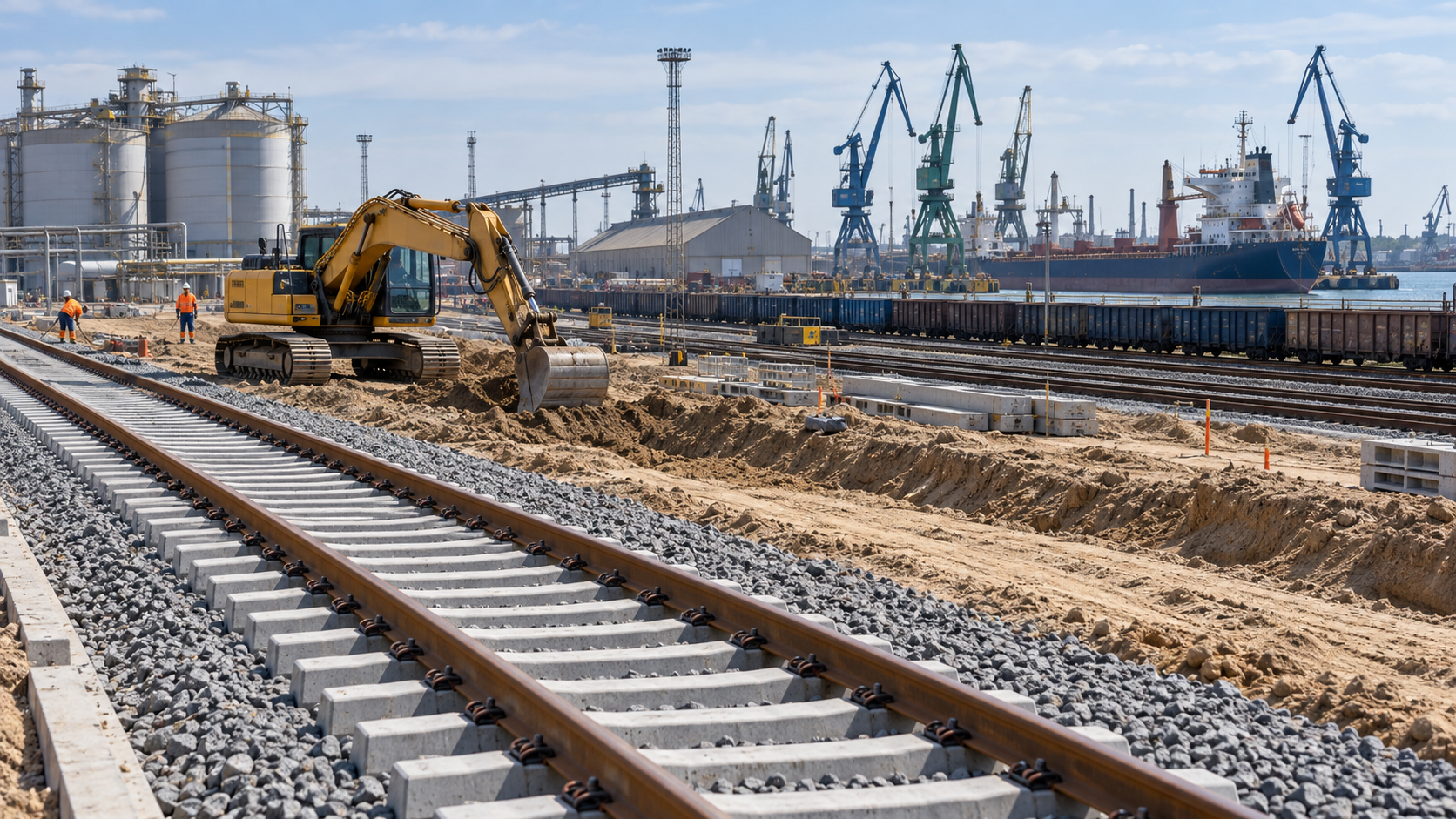
Construction work on part of a major railway project serving Poland’s Port of Police has been temporarily suspended after petroleum-derived contamination was discovered in the soil, raising the prospect of additional costs and delays to the industrial transport investment.
Grupa Azoty Zakłady Chemiczne Police, a Warsaw-listed subsidiary of Poland’s Grupa Azoty chemicals group, disclosed on 16 October that its port-operating subsidiary had identified the contamination during earthworks connected with the construction of a new railway junction.
The company warned that there was a high risk of missing the investment’s planned completion deadline, although the full consequences for the construction schedule could not yet be determined.
The potential cost of treating or removing the contaminated soil also remains unknown.
Construction has not stopped across the entire project. Only earthworks in the affected, designated section have been suspended, while building activities continue elsewhere.
Petroleum contamination discovered during earthworks
According to Grupa Azoty Police’s regulatory disclosure, report 57/2026, the contamination was identified during construction of the railway junction serving the Port of Police, near Szczecin in north-western Poland.
The project forms part of the development of railway line 437, which is intended to provide the maritime port with a direct connection to Poland’s national railway network.
The works are being undertaken by Zarząd Morskiego Portu Police, the port management company controlled by Grupa Azoty Zakłady Chemiczne Police.
Preliminary geo-environmental assessments obtained by the subsidiary indicate that the petroleum-derived contamination is historical rather than the result of recent construction activity.
The parent company described the discovery as a previously hidden physical defect in land over which it holds perpetual usufruct rights, a form of long-term property tenure recognised under Polish law.
Grupa Azoty Police also stated that neither it nor its port-operating subsidiary had caused the contamination.
That remains the company’s position. The regulatory announcement does not independently establish who originally caused the pollution or when it occurred.
The precise extent of the contaminated area and the quantities of affected soil have not yet been established publicly.
Construction continues outside the affected section
Following the discovery, the companies suspended earthworks in the specifically identified section to secure the area and allow more detailed testing.
Other construction activities are continuing.
This distinction is significant because the disclosure does not indicate that the entire railway development, the port or other chemical operations have been shut down.
The company said the eventual effect on the project timetable would depend on the speed of environmental approvals and the extent of earthworks required to deal with the contamination.
It nevertheless identified a high risk that the investment would not meet its previously announced completion deadline.
The company’s October 2024 disclosure concerning the European Union funding agreement provided for completion of the funded project in the first quarter of 2028.
A separate June 2025 government announcement had anticipated completion of the main construction works in the second quarter of 2027.
Those milestones concern different aspects of the project timetable and should not be treated as identical.
No updated completion date has been announced following the contamination discovery.
Remediation could create additional financial costs
Grupa Azoty Police intends to notify the relevant Regional Director for Environmental Protection, the Polish authority responsible for overseeing remediation of contaminated land.
The company said it would seek agreement and approval for a remediation plan.
Under Poland’s environmental protection framework, remediation involves measures to remove, reduce, contain or otherwise manage contamination so that land no longer presents unacceptable environmental or health risks.
The procedure can require investigations into the type and concentration of contaminants, the affected area and the proposed methods of treatment.
The regional environmental authorities’ official guidance explains that remediation plans are normally established through an administrative decision.
Such plans can specify the affected land, contaminants, proposed remedial work and arrangements for confirming that the work has been properly completed.
The Police company has not yet reported that a remediation plan has received regulatory approval.
It has instead begun arranging the valuation of the necessary work with specialist contractors and the project’s general contractor.
Possible costs include the handling and treatment of contaminated excavated material, further environmental investigations and any remediation required by the competent authority.
The company warned that these expenses could fall on Grupa Azoty Police and affect its financial performance.
However, it has not published a financial estimate, provision or revised project budget attributable to the discovery.
PLN 202m railway investment aims to improve port access
The railway junction is part of a wider programme to improve freight access to the Port of Police, an industrial maritime facility on the Oder waterway near Szczecin.
The port supports industrial logistics, including activities connected with the chemicals and fertiliser sector.
The new railway infrastructure is intended to connect the port more directly to Poland’s rail network, allowing freight to move between port facilities and inland destinations without relying exclusively on road transport.
In June 2025, PKP Polskie Linie Kolejowe, Poland’s national railway infrastructure manager, and the Port of Police management company signed a construction contract with Polish engineering group Torpol.
The official project documentation published by the port puts the construction contract at PLN 201.59 million gross, equivalent to approximately $51.9 million or €46.2 million at the National Bank of Poland’s 16 October 2026 exchange rates.
The investment is jointly financed by the port company and PKP Polskie Linie Kolejowe.
It includes the new railway connection, port sidings, signalling and control infrastructure, associated roads and technical facilities.
The wider port infrastructure programme also benefits from European Union financing through the Connecting Europe Facility, which supports transport and infrastructure connections across the European network.
Under the October 2024 grant agreement, the port operator was awarded approximately €33.4 million in EU support for its railway-junction project.
That grant relates to the eligible expenditure under the funded project and should not be confused with the full value of the later construction contract.
Why the railway connection matters to the chemical industry
The Port of Police occupies an important position in the industrial logistics network of north-western Poland.
Its railway investment is designed to support the movement of cargo between maritime transport and inland manufacturing and distribution networks.
Direct rail access could improve the port’s ability to handle larger freight volumes while reducing some of the dependence on road transport.
For industrial operators, rail freight is particularly relevant to bulk commodities and other goods that can be transported economically in large quantities.
The project is also intended to increase the port’s attractiveness for commercial logistics activity beyond its existing industrial operations.
The contamination therefore presents a potential commercial risk beyond the immediate cost of treating polluted soil.
If construction takes longer than planned, the anticipated operational benefits of the railway investment may also be delayed.
However, there is currently no confirmed revised date for the railway connection to enter service, nor evidence that specific freight contracts have been cancelled because of the discovery.
Historical contamination creates uncertainty over liability
The finding also illustrates a wider risk associated with infrastructure construction on land used for industrial purposes over long periods.
Contamination buried beneath the surface may only become apparent once extensive excavation begins.
When polluted soil is identified, construction schedules can become dependent on environmental investigations, regulatory approvals and the technical requirements for remediation.
Polish environmental law distinguishes historical contamination from more recent pollution, with particular rules governing responsibility for remedial action.
The party holding rights to the land may face responsibilities under environmental law even where another party originally caused the contamination.
The legal and financial consequences depend on the circumstances and applicable statutory provisions.
Grupa Azoty Police’s assertion that neither it nor its subsidiary caused the pollution should therefore be distinguished from the separate question of who must organise or finance remediation.
The company has already warned that the necessary expenditure could affect its own financial results.
No final regulatory determination of responsibility for the newly discovered contamination has been disclosed.
Revised costs and timetable still to be established
Grupa Azoty Police said it would provide further market disclosures once reliable estimates of the remediation costs became available and the relevant environmental authority had approved the remedial approach.
The immediate priorities are to determine the extent of the contamination, assess the required treatment and establish how the affected construction work can resume.
The company must also evaluate whether the interruption and associated procedures will affect the completion of the wider investment.
For investors, contractors and port users, the most important outstanding questions concern the financial exposure, the duration of the partial suspension and the timetable for completing railway access to the port.
Until those details are established, the confirmed development remains a localised construction suspension accompanied by a significant risk of delay and additional expense, rather than a confirmed postponement of the entire project.