International construction group PORR has secured a contract worth approximately PLN 539 million gross ($139 million or €123 million) to build military aviation infrastructure for US forces at Wrocław-Strachowice Airport in south-western Poland.
The agreement, signed on 14 October 2026 with the Regional Infrastructure Board in Wrocław, covers the first five of 20 planned construction tasks for a US Air Force logistics and cargo-handling facility known as the Air Port of Debarkation (APOD).
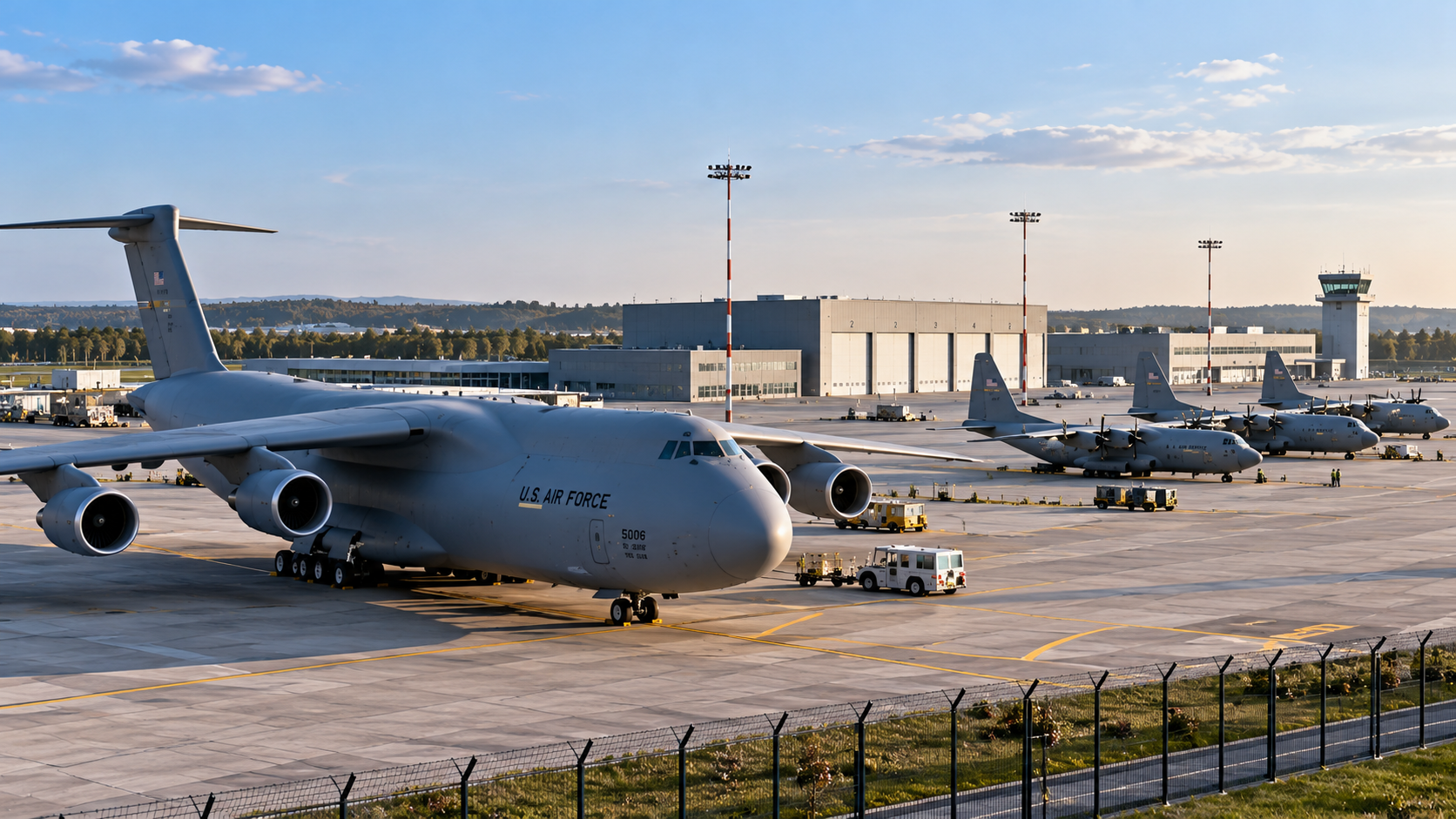
The project includes aircraft parking areas for seven military transport planes, new taxiways, a military fire station and an airport technical-support building.
The infrastructure is intended to support the movement of American military personnel, equipment and supplies through Poland, strengthening the country’s role as a transport and logistics hub for US forces in Europe.
Construction is expected to begin following the handover of the site to PORR, while completion, certification and readiness to receive military aircraft are targeted for 2029.
The PLN 539 million contract covers only the first package of construction tasks, not the full military infrastructure programme.
Seven aircraft parking positions and new taxiways
According to Wrocław’s municipal information service, the signed agreement covers five principal elements of the planned military installation.
The largest components are two aircraft parking areas designed to accommodate different classes of US military transport aircraft.
The first will provide four parking positions for the C-5 Galaxy, one of the largest military cargo aircraft operated by the United States Air Force.
The second will offer three positions for C-130 Hercules transport aircraft, which are used for moving troops, equipment and supplies.
PORR will also construct taxiways connecting the military parking areas to the airport’s wider operating infrastructure.
The remaining two elements are a military fire-service building and a facility for the airport’s duty technical personnel.
The investment will require specialist airport construction capable of supporting heavy military aircraft, together with technical infrastructure meeting the relevant aviation safety and operational requirements.
For construction and engineering companies, the project represents a substantial package of civil engineering, pavement construction, technical installations and specialist building work.
However, no complete breakdown of the PLN 539 million contract by individual construction task has been publicly established.
Work expected to begin after site handover
The agreement was signed by representatives of PORR and the Regional Infrastructure Board in Wrocław, a Polish military infrastructure authority subordinate to the Armed Forces Support Inspectorate.
The contractor was represented by PORR president Piotr Kledzik, while the contracting authority was represented by Colonel Robert Wójcik, head of the Regional Infrastructure Board.
Speaking to Wrocław’s municipal information service on 15 October, Wójcik said the site was expected to be handed over to the contractor the following week, allowing construction to begin.
The planned handover is an important distinction from the signing of the contract itself.
Although the construction agreement is in place, the reported timetable does not establish that all five construction tasks have already begun.
In its own announcement about the contract, PORR said the project would involve work immediately adjacent to the functioning civilian airport.
The company identified coordination with the airport operator and air traffic management authorities as an important requirement.
The contractor also confirmed that the programme targets 2029 for completion of works, certification of the military aviation infrastructure and readiness to accommodate military aircraft.
These remain planned milestones rather than completed operational capabilities.
Part of Poland’s military infrastructure programme for US forces
The Wrocław project forms part of the Enhanced Defense Cooperation Agreement (EDCA) signed by Poland and the United States in August 2020.
The agreement established a framework for expanded US military activities and supporting infrastructure in Poland.
Under the arrangement, Wrocław-Strachowice was designated as a location for a US Air Force aerial port of debarkation.
An APOD is a military air transport facility designed to receive personnel, vehicles and equipment arriving by aircraft and support their onward movement.
Its role extends beyond aircraft parking to include cargo handling, passenger processing and connections with other transport networks.
The published US–Poland defence agreement identifies a wider range of planned facilities at Wrocław, including cargo-handling infrastructure, passenger facilities, rail connections, accommodation, medical support and communications systems.
These elements form part of the broader programme and should not be confused with the five tasks awarded to PORR under the October contract.
The Polish and American governments have designated several other locations for supporting US forces, including Poznań, Powidz and Łask.
Wrocław’s particular function is centred on military air transport and logistics.
Polish defence investment creates construction opportunities
PORR is an international construction group headquartered in Vienna, Austria, with an established presence in Poland and other European markets.
The Wrocław agreement adds a substantial military infrastructure project to its construction activities.
For the company, the award provides contracted work associated with Poland’s defence-related investment programme.
The project could also create opportunities for companies supplying construction materials, specialist airport equipment, engineering services and technical installations.
However, the identity of subcontractors and the geographical distribution of procurement spending have not been fully disclosed.
It would therefore be premature to claim that the entire contract value will benefit Polish suppliers or that a specific number of jobs will be created.
The commercial significance of the award lies in the size of the contract and the specialist infrastructure required.
Military airfield projects can involve demanding pavement specifications, operational safety requirements and construction coordination with existing aviation activities.
The Wrocław contract also illustrates how increased expenditure on defence infrastructure can generate work for civilian construction and engineering businesses, rather than exclusively for manufacturers of military equipment.
Military development separate from civilian airport expansion
The US military logistics project is distinct from the civilian expansion of Wrocław Airport.
The airport operates as a dual-use facility, supporting civilian aviation alongside military activities.
In September 2026, the airport completed a separate programme of improvements to its civilian operational infrastructure, including additional aircraft parking areas, taxiways and other airfield facilities.
According to Wrocław’s official September investment update, that programme was worth more than PLN 464 million gross and was completed ahead of its planned deadline.
The civilian works were commissioned separately from the military APOD programme and should not be included within PORR’s new PLN 539 million contract.
The investments nevertheless share the same wider airport environment.
Coordinating military and civilian infrastructure will be important to maintaining airport operations while expanding the facilities available for larger aircraft.
Further military construction contracts remain
The current PORR agreement is the first contract covering five of the 20 tasks planned for the Wrocław APOD development.
Other proposed elements include cargo-handling facilities, passenger infrastructure, accommodation, medical facilities, communications systems and security-related improvements.
The October agreement does not cover all these components, and the remaining tasks should not be treated as already awarded to PORR.
Further procurement and construction decisions will determine how the wider military logistics facility develops.
The immediate next step is the planned handover of the construction site and the start of work under the signed contract.
For PORR, the agreement represents a major infrastructure order with a delivery horizon extending to 2029.
For Poland’s construction sector, it is another example of defence cooperation generating substantial contracts for transport infrastructure and specialist engineering.
The broader Wrocław military logistics programme remains under development, with the full operational capability of the new facilities still several years away.