
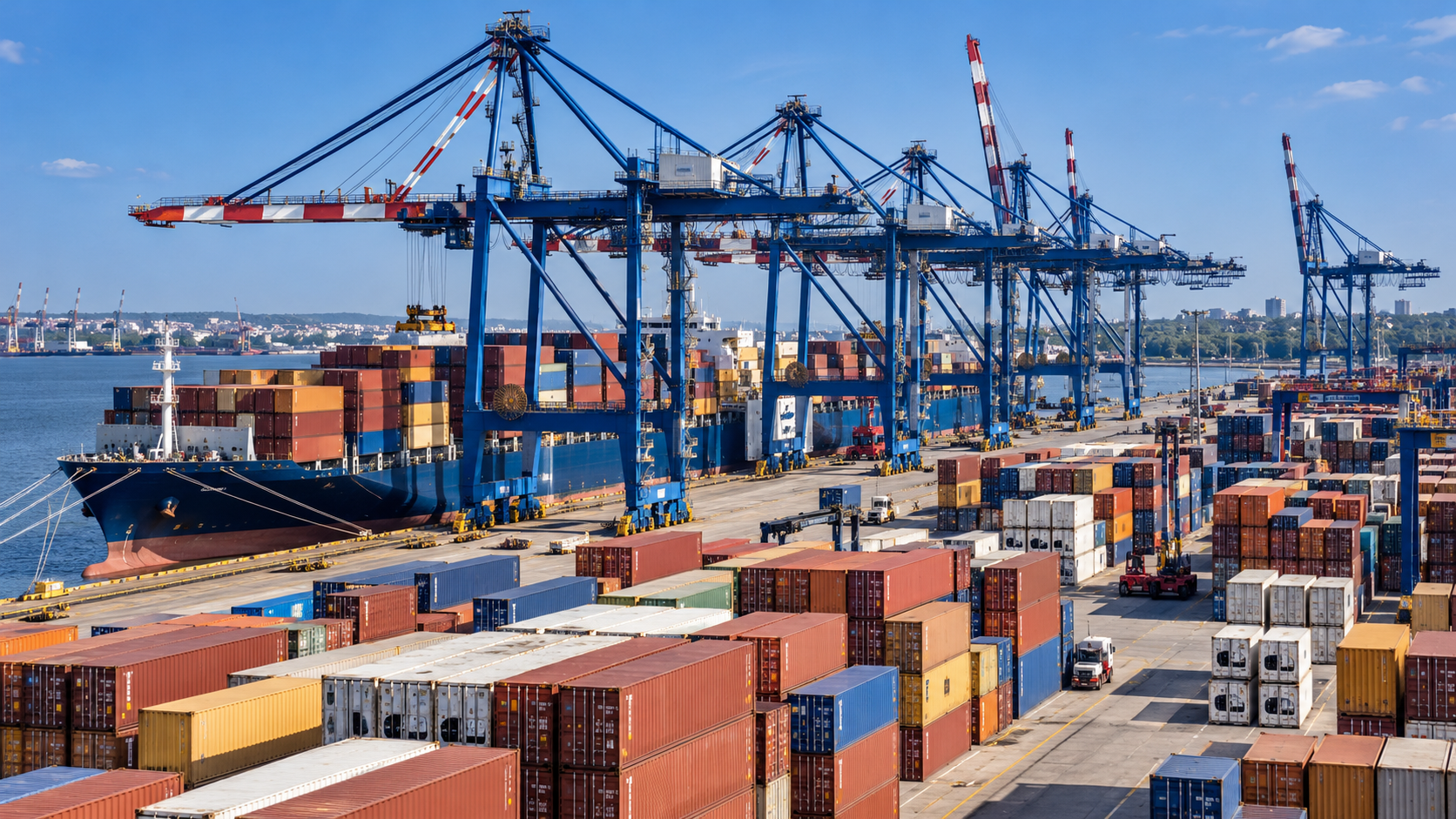
Poland’s merchandise trade deficit widened to PLN 27.9 billion (approximately $7.2 billion or €6.4 billion) in the first eight months of 2026, as the value of imports grew faster than exports, according to official figures published on 14 October.
Statistics Poland (GUS) reported that Polish companies exported goods worth PLN 1,093.0 billion between January and August, an increase of 7.0% compared with the same period in 2025.
Imports reached PLN 1,120.9 billion, rising by 7.5% year-on-year.
Although both exports and imports continued to expand in value, the faster growth in purchases from abroad left Poland with a larger trade deficit than a year earlier.
In euro terms, the deficit increased from €4.8 billion in January–August 2025 to €6.5 billion in the corresponding period of 2026.
Imports grow faster than exports
| Merchandise trade, January–August 2026 | Value | Year-on-year |
|---|---|---|
| Exports | PLN 1,093.0bn | +7.0% |
| Imports | PLN 1,120.9bn | +7.5% |
| Trade balance | −PLN 27.9bn | Deficit |
The figures underline the difference between export growth and the overall trade balance.
A country can increase its exports while still recording a larger deficit if spending on imported goods rises more quickly.
For Poland, the figures show that the value of goods purchased from foreign suppliers exceeded the value of goods sold abroad during the reporting period.
The gap does not necessarily indicate that Polish exporters sold fewer products. Export values increased, but not sufficiently to match the value of imports.
The Statistics Poland figures are measured at current prices, meaning they are not adjusted for inflation. Changes in prices, exchange rates and the mix of traded products can all influence reported values.
Consequently, the 7.0% rise in exports should not be interpreted as an equivalent increase in the physical volume of goods shipped overseas.
What the deficit means for Polish businesses
Poland is closely integrated into European manufacturing and supply chains, making foreign trade an important indicator for companies operating across the region.
Manufacturers rely on international suppliers for machinery, components and industrial materials, while exporters sell finished products and intermediate goods to customers in European and global markets.
For businesses, a widening merchandise trade deficit raises questions about the balance between external demand for Polish products and domestic demand for imported goods.
However, the overall figures do not establish whether the widening gap was primarily driven by energy purchases, capital equipment, consumer products or particular trading partners.
That distinction matters because higher imports can reflect several different economic developments.
Increased purchases of machinery and equipment, for example, may support business investment and future production. Stronger imports of consumer goods could instead reflect household demand, while changes in energy prices can affect the value of Poland’s import bill without a corresponding change in the quantities purchased.
A more detailed assessment therefore requires trade figures broken down by product category and country.
Poland’s trade deficit also widens in euro terms
Statistics Poland reported merchandise exports of €257.3 billion and imports of €263.8 billion for January–August 2026.
Measured in euros, export values rose by 6.7% compared with a year earlier, while import values increased by 7.3%.
The resulting €6.5 billion deficit was €1.7 billion larger than the €4.8 billion deficit recorded during the corresponding period of 2025.
The different growth rates reported in zloty, euro and dollar terms reflect the fact that international trade values are expressed in currencies whose exchange rates change over time.
According to GUS, exports measured in US dollars rose by 12.9%, while imports increased by 13.4%.
These currency-denominated differences do not represent separate measures of physical trade volumes.
Goods trade is not the same as Poland’s current account
The deficit reported by Statistics Poland covers merchandise trade — the international movement of goods.
It should not be confused with Poland’s broader current-account balance.
The current account, measured in Poland by the National Bank of Poland (NBP), includes trade in goods and services, primary income such as investment income and compensation, and secondary income transfers.
Poland can therefore record a deficit in merchandise trade while other components, including services, offset some or all of that shortfall.
The latest GUS data provide a measure of the country’s goods-trade position rather than its complete external economic balance.
Further trade data will clarify the trend
The latest release covers January through August 2026 and does not represent a full-year outcome.
Statistics Poland publishes merchandise trade figures monthly, allowing businesses, analysts and policymakers to assess whether exports are keeping pace with imports and how Poland’s trading relationships are changing.
The statistical office also cautions that previously published figures may be revised as additional customs declarations and INTRASTAT reports, which cover trade between EU member states, become available.
Future releases will help establish whether the widening deficit is continuing and whether the gap is concentrated in particular products or trading relationships.
For now, the confirmed picture is one of continued growth in both exports and imports, but with the latter expanding more rapidly in value.