Poland has established itself as the European Union’s second-largest exporter of packaging, overtaking France and Italy as its manufacturers continue to gain market share despite weak demand across Europe, according to a new industry report from Bank Pekao.
The report, published on 18 November 2026, places Poland fifth among EU packaging producers and second among exporters, highlighting one of the country’s strongest industrial growth stories of recent years.
Polish manufacturers now account for more than 11% of the EU’s packaging exports, while their share of the bloc’s packaging production is approaching 10%.
The industry has also recorded a significant improvement in profitability, with aggregate net profits increasing by 48% year on year during the first six months of 2026.
However, the authors warn that maintaining Poland’s position could become increasingly difficult as manufacturers face stronger competition from Asian suppliers, volatile energy and raw-material prices, and new European environmental regulations.
Poland overtakes France and Italy in packaging exports
According to Bank Pekao’s latest sector report, Poland climbed from fourth to second place among EU packaging exporters between 2019 and 2025.
The country moved ahead of both France and Italy, increasing its share of total EU packaging exports to more than 11% in 2025.
Its position is particularly strong in wooden packaging, where Polish suppliers account for approximately 21% of the EU’s total exports.
Poland is also the bloc’s second-largest exporter of both paper and metal packaging.
The rankings cover packaging products rather than the value of goods shipped inside them. They therefore measure a specific manufacturing industry, not Poland’s overall merchandise exports.
The report shows that Poland’s export expansion continued into 2026.
During the first seven months of the year, the value of Polish packaging exports increased by 4% compared with the corresponding period of 2025.
The improvement was driven mainly by stronger sales to other EU countries, particularly a recovery in exports of plastic and metal packaging, including shipments to Germany.
This is notable because the wider European packaging industry has struggled to return to pre-pandemic levels of production.
One of Poland’s major industrial success stories
Poland’s rise in packaging manufacturing reflects the expansion of an industry serving a broad range of other sectors.
Food and beverage producers, cosmetics manufacturers, pharmaceutical companies, retailers and logistics operators all depend on packaging for their products and distribution networks.
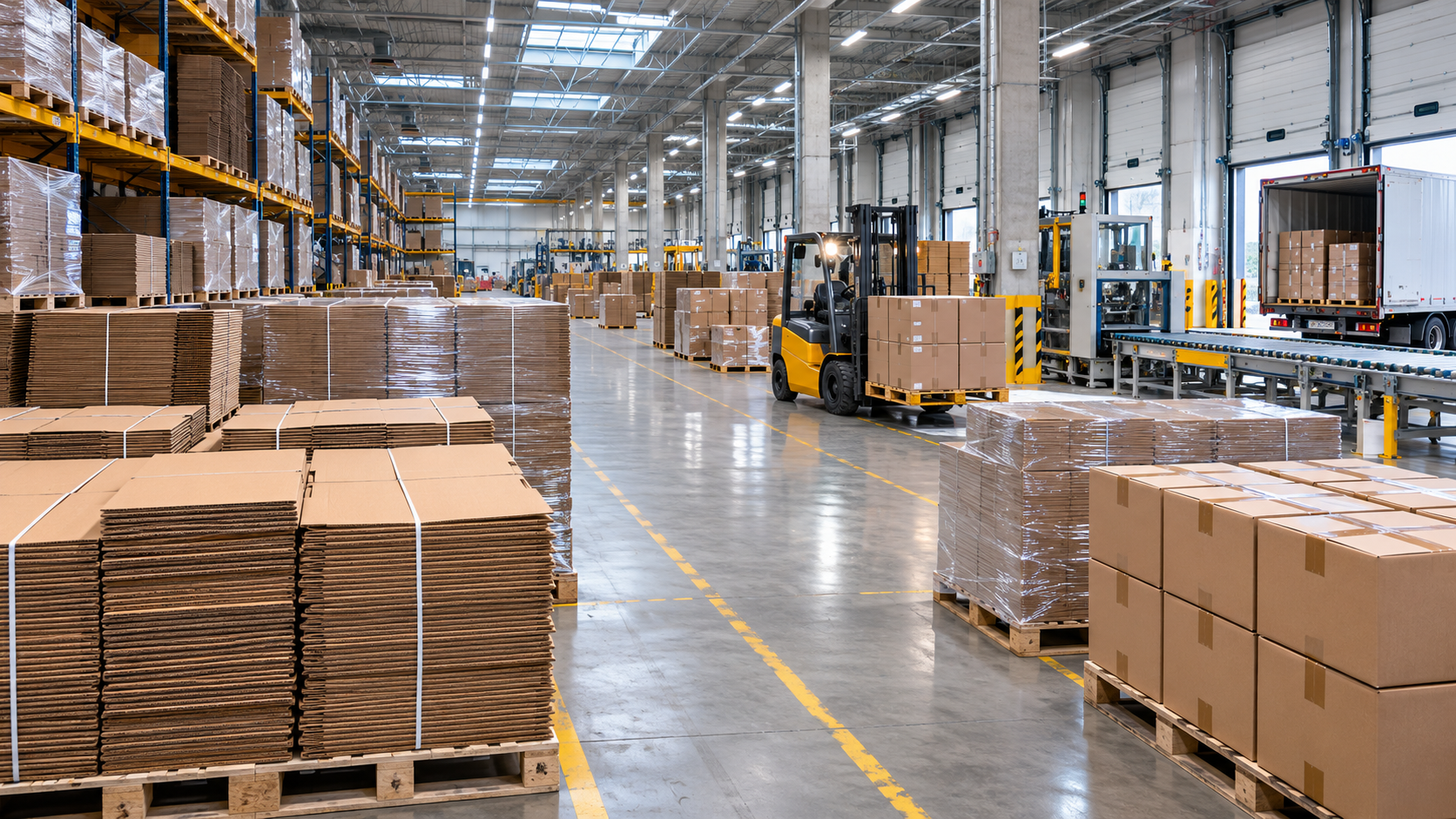
The industry includes cardboard boxes, plastic containers, glass bottles, metal packaging and wooden transport packaging.
Bank Pekao describes the sector as one of the significant long-term success stories of Polish manufacturing.
Between 2020 and 2025, the value of packaging produced in Poland increased by nearly 40%.
However, the bank cautions that part of this increase reflected inflation, particularly during 2021 and 2022, rather than equivalent growth in physical production.
More recently, growth has slowed considerably.
The industry’s sales value stagnated during 2024 and 2025, affected by weaker demand in Poland and other EU markets and by easing price pressures.
Despite those difficulties, Polish producers continued to strengthen their competitive position against manufacturers in Western Europe.
Their share of EU packaging production has increased by more than two percentage points since 2015.
Industry profits rebound by 48%
Poland’s export success has not always translated into stronger financial results for manufacturers.
According to Pekao, the industry’s combined net profits fell by approximately 35% between their peak in 2022 and 2025.
During that period, profit margins declined and the proportion of loss-making businesses increased.
The first half of 2026 brought a substantial improvement.
- Net profit, first half of 2026: up 48% year on year.
- Investment, first half of 2026: up 23% year on year.
- Export value, January–July 2026: up 4% year on year.
The sector’s combined net profit rose 48% compared with the first six months of 2025, while its net profit margin improved by nearly two percentage points.
Paper packaging manufacturers recorded particularly strong results, with net profit margins rising above 8%.
Plastic packaging producers also performed relatively well.
Glass packaging manufacturers, however, remained under pressure. The segment recorded negative overall profitability in the first half of the year, with more than half of companies reporting losses.
Pekao attributes part of the broader improvement to easing labour and energy cost pressures.
The bank also warns that accounting effects associated with significant changes in raw-material and packaging prices may have contributed to the reported increase in profits.
Consequently, the first-half results should not automatically be interpreted as evidence of a lasting improvement across every part of the industry.
Investment recovers as manufacturers modernise
The improvement in profitability was accompanied by renewed investment.
Capital expenditure among Polish packaging manufacturers increased by 23% year on year in the first half of 2026, following a 24% decline during 2025.
Much of the renewed spending was directed towards machinery and production equipment.
Automation is becoming increasingly important as companies seek to improve productivity and manage labour costs.
Modern production facilities can help manufacturers increase output, reduce material waste and respond to changing requirements from industrial customers.
For Polish producers competing with companies in both Western Europe and lower-cost markets, these investments could become increasingly important to retaining customers.
The report’s authors suggest that future competitiveness will depend less on production costs alone and more on efficiency, technology and the ability to meet customers’ changing requirements.
Chinese competition is growing
One of the greatest challenges identified by the report is competition from lower-cost manufacturers, particularly those based in China.
Chinese packaging producers have expanded their position in European markets, especially in glass and plastic products.
According to Pekao’s findings, Chinese products now account for nearly 10% of the value of Poland’s packaging imports, an increase of approximately four percentage points since 2019.
Competition is particularly pronounced in glass packaging, where China accounts for approximately 22% of Polish imports by value.
This creates pressure on domestic producers to maintain competitive prices while investing in more efficient equipment and adapting to new environmental requirements.
The challenge is not confined to Poland.
Across the EU, the volume of packaging production in major categories remains below its 2019 level.
The European sector’s trade surplus has also narrowed, and during the first eight months of 2026 the EU became a small net importer of packaging by physical volume, according to Pekao.
Poland’s growing export share therefore comes against the background of a European industry facing structural difficulties.
New EU packaging rules create further challenges
Manufacturers must also adapt to significant changes in European packaging legislation.
The EU’s Packaging and Packaging Waste Regulation, commonly known as PPWR, began applying on 12 August 2026, with additional requirements scheduled to take effect in subsequent years.
The legislation is intended to reduce packaging waste, improve recyclability and establish more consistent rules across the European single market.
According to the European Commission’s official explanation, the framework includes restrictions on certain substances in food-contact packaging, with harmonised labelling requirements expected from 2028 and further recycling and reuse-related requirements applying from 2030.
For manufacturers, the changes affect product design, materials, production processes and documentation.
Some companies will need to invest in new equipment or adapt existing production lines to comply with the requirements.
Poland’s deposit-return system and extended producer responsibility rules add further considerations for manufacturers and their customers.
Ewa Kurek, co-author of the Pekao report, argues that compliance could also create commercial opportunities.
Packaging designed to help customers satisfy environmental rules while controlling costs may become a stronger competitive advantage.
Products that are easier to recycle could, depending on the applicable rules, reduce certain costs for companies purchasing packaging.
However, the overall commercial benefit will depend on investment requirements, production costs and customer demand.
Maintaining Poland’s position will be the next test
The report presents a mixed outlook for 2027.
Poland’s packaging manufacturers enter the year with a strong position in European trade and signs of improving financial performance.
Nevertheless, the industry’s future will depend partly on developments outside companies’ control.
Energy prices, raw-material costs, consumer demand and geopolitical uncertainty could all affect profitability.
The report also expects growth in Polish consumption and exports to moderate somewhat during 2027.
Krzysztof Mrówczyński, a manager in Bank Pekao’s Sector Analysis Team and co-author of the study, warned that rising cost competition will make defending established advantages increasingly important.
The findings suggest that Polish packaging manufacturers have already demonstrated their ability to compete with major Western European producers.
Their next challenge is to maintain that position while adapting to higher regulatory demands and more intense competition from international suppliers.
Poland’s position as the EU’s second-largest packaging exporter is firmly established in the latest report. Whether the industry can continue expanding at the same pace will depend on how effectively producers respond to those pressures.