
Poland’s government has approved draft legislation designed to accelerate nuclear-energy investments by simplifying construction procedures, removing administrative obstacles and strengthening financial protections for subcontractors involved in the country’s first nuclear power plant.
The Council of Ministers approved the proposed amendments on 10 November 2026, marking another step in Poland’s efforts to develop its first commercial nuclear-power programme.
The reforms would introduce indefinite validity for nuclear-project location decisions, allow selected technical documentation to be submitted in English and establish additional payment protections for construction subcontractors.
They would also adjust the annual allocation of government funding already earmarked for the first nuclear project to better reflect its implementation schedule.
The changes are particularly relevant to Polish Nuclear Power Plants, known as Polskie Elektrownie Jądrowe (PEJ), and international companies participating in the development of the country’s first large-scale nuclear facility.
However, the legislation has only received Cabinet approval. It must still complete Poland’s parliamentary and presidential legislative procedures before becoming law.
Government targets obstacles to nuclear investment
The amendments concern Poland’s special legislation governing the preparation and implementation of nuclear-energy facilities and associated infrastructure.
The proposed law, registered as UD382, was prepared by Wojciech Wrochna, the government’s commissioner for strategic energy infrastructure.
According to the Ministry of Energy’s announcement on 10 November, existing procedures do not always reflect the complexity and long construction periods associated with nuclear infrastructure.
Nuclear-power projects typically require multiple administrative decisions, detailed engineering documentation, environmental assessments, specialist safety reviews and extensive coordination between investors, regulators and contractors.
The government argues that unnecessary administrative complications can make such projects harder to implement and increase uncertainty for participating businesses.
Energy Minister Miłosz Motyka said the reforms were intended to make the investment process more predictable and facilitate cooperation between companies involved in nuclear construction.
He also identified the development of Polish industrial capabilities and technological expertise as important objectives of the wider nuclear programme.
Nuclear location decisions would no longer expire after 10 years
One of the most significant proposals concerns the duration of nuclear-project location decisions.
Under the existing rules identified by the government, these decisions may be issued for a maximum period of 10 years.
The proposed legislation would allow them to remain valid indefinitely.
For nuclear projects that can take well over a decade to prepare and build, this could remove uncertainty surrounding the expiry of a location decision before the investment is completed.
The government also wants to simplify the procedures governing changes to location decisions and permits for preparatory works.
Under the proposal, changes to certain final decisions would require the consent of the investor that originally applied for them, rather than obtaining consent from every party to the original administrative proceedings.
The Cabinet’s detailed decision also provides for simpler arrangements for obtaining perpetual usufruct rights over state-owned land.
Perpetual usufruct is a form of long-term land-use right under Polish law, rather than outright freehold ownership.
For nuclear investors, clearer land-access arrangements could reduce administrative uncertainty when preparing construction sites and associated infrastructure.
These changes would not themselves constitute planning permission for a new nuclear facility or replace the separate nuclear-safety authorisations required for construction.
English-language technical documents could reduce administrative costs
The proposals also address the extensive technical documentation required for nuclear projects.
Nuclear technology involves international suppliers, specialist engineering companies and large volumes of documentation originally produced in English.
Under the proposed changes, investors could submit selected documents in English during proceedings before Poland’s National Atomic Energy Agency, known as Państwowa Agencja Atomistyki (PAA).
Such submissions would require the appropriate consent or opinion of the PAA president, depending on the procedure.
The regulator and courts would retain the ability to request Polish translations when necessary.
The measure could reduce the administrative burden associated with translating extensive engineering and technical materials, particularly for international contractors.
However, it would not establish an unrestricted right to conduct all nuclear-licensing proceedings in English.
The draft also clarifies how particularly sensitive technical and technological information should be handled.
This includes documentation concerning nuclear-safety analyses and materials protected by intellectual-property rights.
The aim is to improve access to necessary information while maintaining appropriate safeguards.
Stronger payment protections for nuclear subcontractors
The legislation includes an important provision for construction businesses participating in Poland’s first nuclear-power project.
The government proposes a mechanism under which PEJ, the state-owned project developer, would assume specified responsibilities for direct payment to subcontractors and further subcontractors carrying out qualifying construction works.
The measure is intended to provide greater protection against non-payment within complex contracting arrangements.
Large infrastructure projects frequently involve multiple contractual layers, with a principal contractor engaging specialist companies that may themselves employ additional subcontractors.
For smaller construction and engineering businesses, delayed payments can create serious cash-flow difficulties.
The proposed arrangements could provide additional financial security to eligible companies working on the first Polish nuclear plant.
However, the mechanism is specifically linked to that project and the statutory conditions that would govern its application.
It should not be interpreted as a general government guarantee of payment to every supplier involved in Poland’s nuclear programme.
The proposal also allows parties to certain contracts connected with the first plant to specify exclusive grounds and consequences for withdrawal from their agreements.
The government says this would provide contractual flexibility reflecting the particular requirements of nuclear construction.
The precise commercial effect would depend on the final statutory wording and individual contract terms.
Changes to annual funding limits
The proposed reforms also address the financing timetable for Poland’s first nuclear-power plant.
The government intends to adjust the annual limits on state-budget expenditure used to support PEJ, bringing them more closely into line with the project’s financing requirements.
Under the updated Polish Nuclear Power Programme approved in September, Poland has provided for PLN 60.2 billion (approximately $15.4 billion or €13.7 billion) in capital injections into the first nuclear project during 2025–2030.
The financing structure also includes debt financing supported by domestic and international institutions.
The November proposal concerns adjustments to the annual spending limits within the project’s financing framework.
It should not be interpreted as an announcement of an additional PLN 60.2 billion or a newly approved increase in the overall construction budget.
The final implications for annual expenditure will depend on the legislation adopted by parliament and the subsequent implementation of the financing arrangements.
What this means for Poland’s first nuclear plant
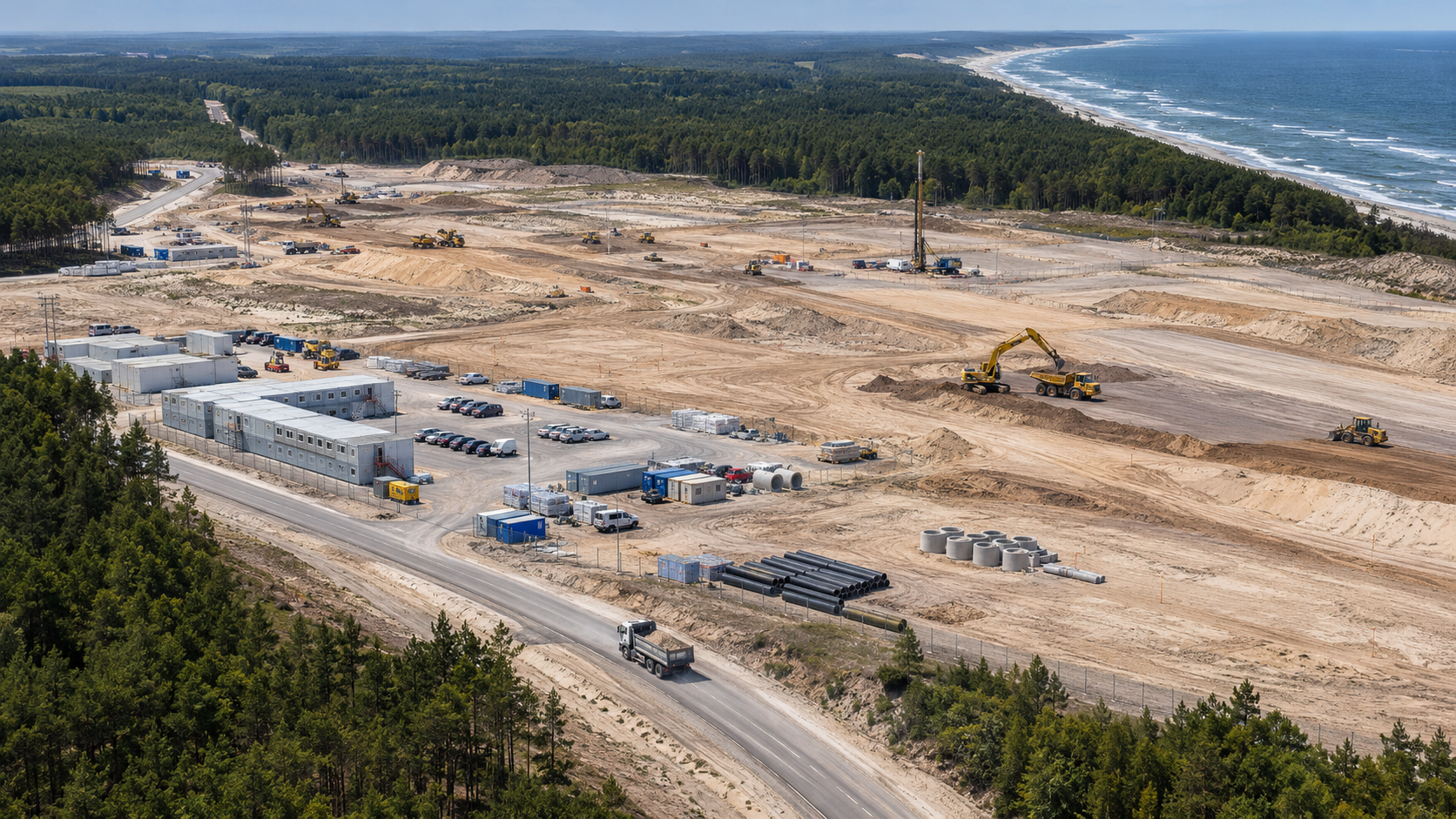
The most immediate beneficiary of the proposed reforms would be Poland’s first commercial nuclear-power plant at Lubiatowo-Kopalino, in the municipality of Choczewo on the Baltic coast.
The project is being developed by PEJ using three Westinghouse AP1000 reactors, with a planned combined generating capacity of approximately 3.75 gigawatts.
The American Westinghouse-Bechtel consortium is responsible for the project’s engineering and construction work.
Preparatory works are already under way, including infrastructure development and geological investigations.
PEJ submitted its application for a nuclear construction licence to the PAA on 31 March 2026.
That nuclear-safety authorisation is separate from the building permit issued through Poland’s construction administration.
According to the Energy Ministry’s project timetable, the company plans to apply for the building permit in 2027.
The current government schedule envisages the first nuclear concrete being poured in the fourth quarter of 2028, with the first reactor entering commercial operation in 2036.
The remaining two reactors are scheduled to begin operating in 2037 and 2038.
The November reforms are intended to support the delivery of the project, but the government has not established that the legislative changes will bring these milestones forward.
Nuclear regulation and safety requirements remain essential
The proposed simplifications concern the administration and implementation of nuclear investments.
They do not mean that nuclear projects would be exempt from technical safety requirements or independent regulatory scrutiny.
The PAA remains responsible for assessing nuclear safety and radiological protection and issuing the relevant nuclear authorisations.
Its licensing framework requires detailed assessments of reactor technology, design, safety systems and operating arrangements.
The regulator also examines the documentation submitted by investors and conducts inspections involving facilities, suppliers and contractors.
The proposed rules concerning English-language documentation and the handling of sensitive information must therefore be understood within the continuing nuclear-safety licensing process.
Likewise, changes to location decisions and administrative procedures should not be confused with the elimination of environmental or safety obligations.
Opportunities for Polish and international businesses
Poland’s nuclear programme represents a potentially substantial market for construction companies, engineering contractors, equipment manufacturers and specialist service providers.
The government’s broader strategy includes developing domestic industrial capabilities so Polish companies can participate in the construction, maintenance and operation of nuclear facilities.
Sectors identified as particularly relevant include steel manufacturing, mechanical and electrical engineering, automation, transport, logistics and specialist construction.
The September programme update estimated that Polish companies could account for approximately 40% of the value associated with constructing the first reactor, with potentially higher participation in subsequent units.
Those figures are planning estimates, not completed procurement commitments or guaranteed contract allocations.
For international companies, the proposed ability to submit selected technical documents in English could make cooperation with Polish regulators and project developers less administratively burdensome.
For Polish contractors, the subcontractor-payment provisions and greater contractual predictability could improve the commercial environment for participation.
However, the actual opportunities available to individual businesses will continue to depend on procurement decisions, technical qualifications, certification requirements and the contracting arrangements used by the project developer.
Poland is planning a second nuclear-power plant
The reforms also form part of Poland’s broader strategy to develop two large nuclear-power stations.
The September 2026 update to the Polish Nuclear Power Programme envisages combined capacity of up to 9 gigawatts across the two projects.
While the first plant is progressing through preparation and licensing, the second project remains at an earlier development stage.
Bełchatów and Konin are the preferred locations, although the final site has not been selected.
The government aims to choose a strategic technology partner in 2027, begin construction around 2032 and bring the first reactor into service around 2040.
These remain proposed project milestones.
Some of the broader administrative changes in the November bill could be relevant to later nuclear investments, but the specific subcontractor-payment mechanism and contractual provisions concerning the first plant should not automatically be assumed to apply to the second project.
What happens next?
The Cabinet-approved draft must now proceed through Poland’s legislative process.
It requires consideration by the Sejm and Senate, followed by the applicable presidential procedures and publication in the Journal of Laws before it can become binding legislation.
According to the government’s published decision, the proposed amendments would generally take effect seven days after their publication in the Journal of Laws.
No actual commencement date has yet been established.
For businesses involved in nuclear investment, the key developments to monitor will be the final rules governing administrative decisions, land access, technical documentation and subcontractor-payment protections.
The legislation is another attempt to reduce the administrative and commercial obstacles associated with Poland’s nuclear-energy programme.
Its ultimate significance will depend on the final law, how regulators and project developers implement its provisions, and whether the changes produce measurable improvements in project delivery.