
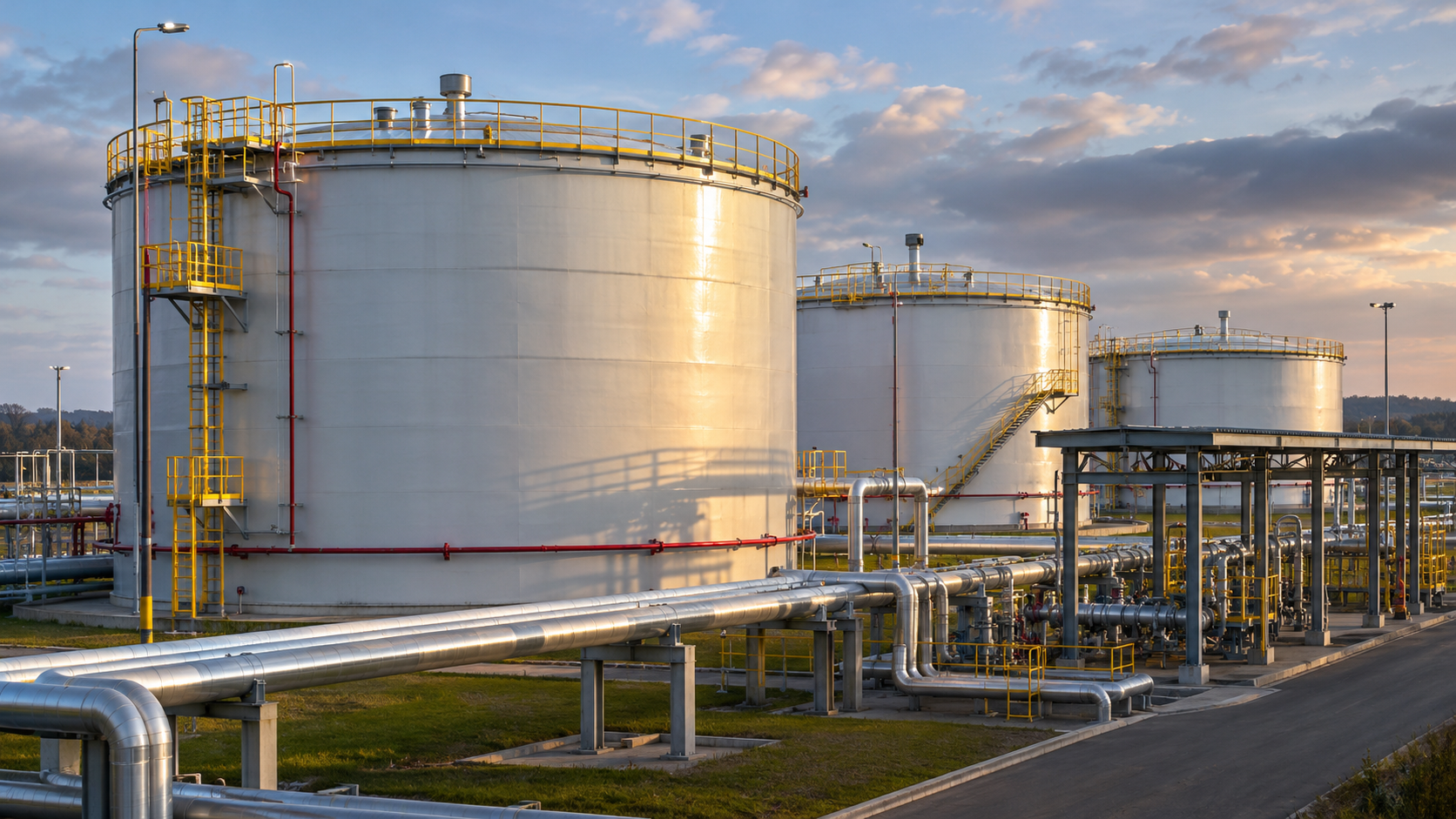
Poland’s government has approved draft legislation tightening mandatory oil and fuel-reserve requirements, with new obligations for producers and importers, stronger regulatory controls and financial penalties that could apply personally to company managers.
The Council of Ministers approved the proposals on 17 November 2026, seeking to close regulatory loopholes that the government says have allowed some businesses to avoid the costs of maintaining strategic fuel stocks.
Under the proposed changes, qualifying companies would have to meet reserve and stockholding-fee obligations from their first unit of fuel production or crude-oil and fuel imports.
Businesses suspending or permanently ending their operations would generally remain responsible for maintaining required reserves for another 12 months, while executives could face penalties of up to ten times Poland’s statutory monthly minimum wage for qualifying violations.
The legislation would also expand the powers of the Government Strategic Reserves Agency, known as RARS, to oversee companies and acquire oil and fuel stocks.
The Cabinet-approved proposal, registered as UD399, was sent to the Sejm on 17 November. It must still complete the legislative process and is not yet in force.
Why Poland wants stricter fuel-reserve rules
Poland maintains emergency oil and fuel stocks to protect the country against serious supply disruptions.
The system combines mandatory stocks held by qualifying fuel producers and traders with reserves maintained by the Government Strategic Reserves Agency, or Rządowa Agencja Rezerw Strategicznych (RARS).
These reserves can help support the market during major interruptions to supplies, although their release is subject to established legal and operational arrangements.
The existing system, explained by RARS, also helps Poland meet European Union requirements for maintaining emergency oil stocks.
Under EU rules, member states must hold emergency stocks equivalent to at least 90 days of net imports or 61 days of inland consumption, whichever is higher.
The government argues that some companies have exploited weaknesses in Poland’s national stockholding rules, creating unequal conditions between fuel businesses.
According to the Ministry of Energy, market monitoring identified arrangements in which companies under common ownership successively started and stopped operations before becoming subject to the full ongoing costs of maintaining reserves.
The government believes these practices could weaken the continuity of strategic stocks and give some operators an advantage over competitors that meet their obligations.
The proposed legislation is intended to make those responsibilities harder to avoid.
Fuel-reserve obligations would begin with the first unit
One of the central changes concerns when a producer or importer becomes subject to stockholding and stock-fee obligations.
Under the proposed rules, qualifying businesses beginning fuel production or importing crude oil and petroleum products would become liable from the first unit of product covered by the legislation.
The same principle would apply to businesses resuming qualifying activity after an interruption lasting more than two years.
The change would tighten the existing arrangements governing the first year of business activity.
Under current RARS guidance on mandatory reserves, new producers and importers already face stockholding obligations, but the calculation and commencement arrangements differ from those now proposed.
The reform would therefore change the timing and calculation of existing responsibilities rather than introducing an entirely new reserve system.
For international fuel traders entering Poland, the practical consequences could include earlier reserve-financing requirements and the need to incorporate stockholding costs into commercial plans from the start of operations.
Companies would also need to consider the effect on working capital, storage arrangements and compliance reporting.
The government has not established a single cost increase applicable to every operator. The financial effect would depend on the volume and type of qualifying fuel, the company’s activities and the detailed statutory requirements.
Companies ending operations could face 12 months of additional obligations
The draft would also change what happens when a fuel producer or importer interrupts or permanently ends its qualifying operations.
Currently, a company’s departure from the market can affect its reserve obligations and its registration within the national stockholding system.
The government wants to prevent sudden reductions in compulsory reserves caused by companies closing or suspending their activities.
Under the proposal, an affected business would generally have to maintain the required stocks for 12 months after the relevant interruption or notification of permanent cessation.
For an interruption, the period would run from the date the business activity stops.
For permanent closure, the proposed period would be linked to the entry in the relevant register recording the company’s intention to cease its activity.
This could have significant financial implications for companies withdrawing from the Polish fuel market.
A business could remain responsible for reserve storage, associated contracts and other compliance costs even after it stops trading.
The exact treatment of individual cases would depend on the final law, including any applicable transitional or exemption provisions.
RARS could acquire reserves from departing businesses
The proposed legislation would introduce a mechanism allowing affected companies to ask RARS to purchase their oil or fuel stocks.
This could provide an alternative to maintaining certain reserves after operations have been suspended or ended.
However, the arrangement would not give businesses an automatic right to sell their stocks to the state.
According to the Energy Ministry’s explanation of the reforms, RARS would examine applications according to several criteria.
These would include the agency’s available financial resources, the need for additional strategic stocks, the type and quantity of fuel concerned, its location and the financial or contractual consequences of acquisition.
The agency could purchase qualifying mandatory or commercial stocks and incorporate them into reserves held on behalf of the state.
Under specified conditions, it could also assume rights and obligations connected with contracts relating to the acquired stocks.
For companies leaving the market, this could offer a means of transferring certain reserve-related responsibilities, although acceptance would remain dependent on the agency’s assessment.
For RARS, the changes would provide greater flexibility in managing the national stockholding system.
Tougher checks before fuel companies can deregister
The proposals would strengthen controls over businesses recorded in the Rejestr Systemu Zapasów Interwencyjnych (RSZI), Poland’s Intervention Stocks System Register.
The register identifies businesses covered by the relevant oil and fuel-reserve requirements.
Under the proposed rules, the president of RARS would conduct a check before removing a company from the register.
The agency could refuse deregistration where the business had failed to meet statutory obligations or where other specified grounds existed.
These could include outstanding stockholding-fee payments, unresolved proceedings, ongoing inspections or inconsistencies in the company’s registered information.
In certain circumstances, the business would have an opportunity to settle outstanding liabilities or explain and correct discrepancies before a final decision.
The government argues that these controls would make it harder for companies to escape reserve obligations simply by formally ending their participation in the system.
The changes could also lengthen and complicate the process of closing or restructuring qualifying fuel operations.
Repeated deregistration could prevent companies from returning
A separate proposal addresses businesses repeatedly entering and leaving the stockholding register.
Under the draft, a company removed from the RSZI at least twice within five years would generally face restrictions on re-entering certain regulated fuel activities.
The restrictions could prevent a new entry in the register of importing entities or the granting of specified fuel-sector licences.
Some related businesses could also be affected.
The government says the provisions are intended to prevent companies from repeatedly changing their corporate arrangements to avoid reserve responsibilities.
However, the proposed restrictions include exceptions concerning legitimate organisational changes, restructuring and legal succession.
A previous deregistration would therefore not necessarily result in a permanent prohibition on future fuel-market activity.
The final scope of restrictions, their application to related companies and the circumstances in which exemptions are available will depend on the legislation adopted by parliament.
Company managers could face personal financial penalties
The proposed amendments would also expand responsibility for breaches of fuel-reserve regulations.
Under the government’s proposal, financial penalties could be imposed not only on the companies concerned but also on individuals responsible for managing their activities.
Personal liability could arise where a manager’s action or failure to act contributed to a statutory violation.
The proposed framework also refers to failures to exercise appropriate care in fulfilling regulatory responsibilities.
The maximum penalty for a qualifying manager would be ten times Poland’s statutory monthly minimum wage.
Because the threshold is linked to the minimum wage, its monetary value would depend on the relevant statutory amount rather than being a fixed permanent sum.
The government has not proposed that every company director automatically becomes personally liable whenever a business breaches its reserve obligations.
A penalty would depend on the applicable legal conditions and the individual’s responsibility for the violation.
For corporate boards and senior managers, the proposals strengthen the case for ensuring that stockholding compliance is clearly assigned, monitored and documented.
Businesses may need to review internal responsibility structures, audit procedures and arrangements for reporting reserve positions and fee payments.
What would the reforms mean financially?
For qualifying oil and fuel businesses, the proposals could affect operating costs, working capital and long-term commercial arrangements.
Mandatory reserves require companies to finance or otherwise arrange access to stocks that are held for emergency purposes rather than ordinary immediate sale.
Maintaining these stocks involves inventory financing, storage and other operational costs.
Companies also pay a stockholding fee, known in Poland as opłata zapasowa, which supports the agency-held component of the reserve system.
The proposed changes could affect businesses in several ways.
New entrants may have to account for reserve-related costs earlier. Companies suspending operations could face extended commitments, while management teams would confront additional financial exposure for qualifying compliance failures.
On the other hand, the proposed RARS purchase mechanism could give some departing companies an additional route for managing their remaining reserves.
The government’s wider argument is that consistent enforcement would create fairer competition between businesses that comply with stockholding requirements and those that attempt to avoid them.
However, no verified sector-wide estimate establishes how much the reforms would increase compliance expenditure or how the costs would be distributed between individual companies.
The legislation should not be interpreted as automatically increasing petrol or diesel retail prices by a particular amount.
Why the changes matter internationally
Poland is an important market for oil products and fuel trading within Central Europe.
Its fuel supply chains involve domestic production, imported crude oil, cross-border trading and internationally connected energy companies.
Businesses operating across several European markets must comply with the individual national arrangements used to meet wider EU energy-security obligations.
The proposed reforms could therefore be relevant to international fuel importers, trading groups and foreign-owned subsidiaries operating in Poland.
They could also influence how companies structure market entry, financing, storage agreements and exit procedures.
For established operators, stricter enforcement could reduce the competitive advantage potentially gained by businesses avoiding reserve-related costs.
For new entrants, the same rules could make initial operations more expensive and administratively demanding.
The balance between these effects will depend on the final legislation and how the authorities apply it.
When could the new rules take effect?
The legislation remains a government-approved draft and has not completed the parliamentary process.
The Cabinet-approved bill was transmitted to the Sejm on 17 November 2026, but parliamentary passage and presidential action remain outstanding.
There is also a discrepancy between the government’s published explanations concerning the proposed commencement date.
The Ministry of Energy says the legislation is intended to enter into force 21 days after publication in the Journal of Laws.
The Cabinet’s separate summary refers to 1 January 2027.
Consequently, neither date should currently be treated as a confirmed commencement date.
The final timetable must be determined from the legislation ultimately enacted and published.
What happens next?
The bill must proceed through the Sejm and Senate before completing the remaining constitutional stages of the legislative process.
For businesses, the main developments to monitor will be the final rules concerning the start of reserve obligations, continued stockholding after operations cease, RARS acquisition procedures and the conditions for imposing management penalties.
Companies already subject to stockholding requirements should continue complying with the law currently in force rather than treating the draft provisions as operational.
If adopted, the reforms could substantially change the compliance environment for Poland’s fuel producers and importers.
Their central purpose is to strengthen the continuity of strategic reserves while reducing the opportunities for businesses to avoid responsibilities through changes in operating status.
For the energy industry, the legislation represents a potentially important shift towards tighter oversight, longer-lasting stockholding obligations and greater personal accountability for management.