
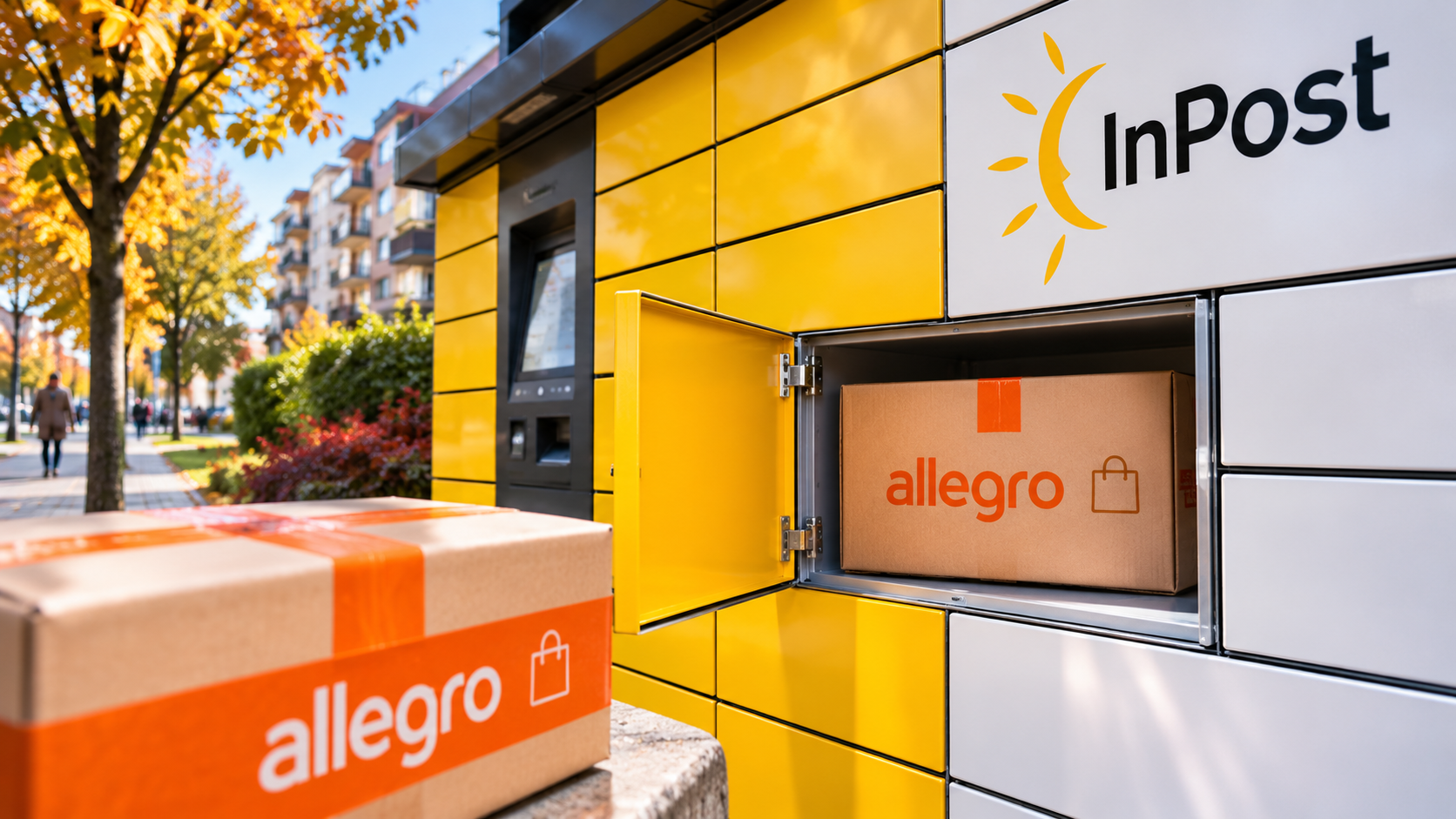
Polish e-commerce platform Allegro and parcel-delivery operator InPost have signed a long-term logistics agreement worth at least PLN 8 billion (approximately $2 billion or €1.81 billion), resolving a major commercial dispute between two of Poland’s most important e-commerce businesses.
The agreement, signed on 11 November 2026 and formally disclosed to investors the following day, establishes new terms for parcel deliveries through InPost’s extensive network of automated parcel lockers.
It replaces the companies’ previous agreement from September 2020 and will remain in force until 31 December 2031, with Allegro holding the right to extend it by another two or three years.
The new contract introduces lower delivery prices, volume-based discounts and guarantees concerning parcel-locker availability and service quality.
Allegro expects the revised pricing arrangements, including discounts applied retrospectively to deliveries throughout 2026, to improve its adjusted earnings before interest, tax, depreciation and amortisation (EBITDA) by PLN 270–280 million (approximately $67–70 million).
The agreement also resolves the companies’ arbitration dispute. Both sides have agreed to end the proceedings, with InPost undertaking to withdraw its claim.
The details were confirmed in Allegro’s stock-exchange disclosure, current report 59/2026, published on 12 November.
What the PLN 8bn agreement covers
The contract governs out-of-home parcel deliveries, particularly purchases made through Allegro that are delivered to InPost’s automated parcel lockers rather than customers’ homes.
Such deliveries are an important part of Poland’s e-commerce market, allowing consumers to collect their purchases from automated lockers at a convenient time.
Under the agreement, InPost will provide long-term delivery capacity and meet specified service standards, including requirements concerning parcel-locker availability and quality indicators.
Allegro will benefit from a new commercial pricing structure intended to reduce its delivery costs and make those costs more predictable.
The contract introduces lower delivery rates, revised price-indexation arrangements and prices that depend on parcel volumes.
This means the commercial terms take account of the scale of deliveries handled under the partnership.
The approximately PLN 8 billion figure represents the minimum value of logistics services over the agreement period from 2026 to 2031.
It is not an immediate payment from Allegro to InPost, nor does it represent profit earned by either company.
The two businesses described the agreement in their joint announcement as the largest logistics contract in the Polish market.
For InPost, the deal secures a substantial volume of parcel-handling business over several years.
For Allegro, it provides access to delivery infrastructure that can support the growth of its online marketplace.
The agreement also maintains cooperation on marketing services between the companies.
Allegro expects PLN 270–280m financial benefit in 2026
One of the most significant elements for investors is the immediate expected financial impact on Allegro.
The company says the new contract will substantially reduce the delivery rates it pays compared with the previous arrangement.
Importantly, the pricing changes are not limited to deliveries made after the November signing.
The agreement provides for volume-based rebates that reduce the rates applicable to the entire 2026 calendar year, provided the relevant contractual conditions are satisfied.
Allegro estimates that the retrospective application of these lower prices will increase its adjusted EBITDA for 2026 by PLN 270–280 million.
Adjusted EBITDA is a measure of operating profitability before financing costs, taxation, depreciation and amortisation, with additional adjustments determined by the company’s reporting methodology.
It is commonly used by investors to assess business operating performance.
However, the estimated benefit should not be confused with additional sales revenue, net profit or cash already received.
The final effect will depend on the contractual conditions, accounting treatment and actual delivery activity.
The benefit is particularly significant because logistics costs are an important component of Allegro’s operating expenses.
Lower delivery charges can improve the profitability of marketplace transactions without requiring an equivalent increase in the prices paid by customers.
The company also incorporated the expected benefits of the InPost agreement into its revised full-year financial outlook, published alongside its third-quarter results on 12 November.
Those forecasts remain management estimates rather than completed financial results.
Arbitration dispute resolved through commercial settlement
The agreement also ends a significant period of tension between the two businesses.
InPost had accused Allegro of breaching provisions of their previous delivery contract, amid disagreements concerning how different parcel-delivery options were presented to customers.
The dispute arose as Allegro expanded its own logistics services and parcel-locker network, competing more directly with InPost.
InPost sought a contractual penalty of approximately PLN 98.7 million, alleging that Allegro had failed to meet obligations under their existing commercial arrangements.
Allegro disputed the claim and maintained that it was unfounded.
The disagreement was referred to arbitration, a procedure in which commercial disputes are considered outside the ordinary court system under the parties’ contractual arrangements.
In June 2026, the two companies signed a non-binding letter of intent setting out plans for a new long-term delivery agreement.
The arbitration proceedings were subsequently suspended while negotiations continued.
The new agreement signed in November resolves that commercial dispute.
According to Allegro’s regulatory disclosure, the parties have agreed to terminate the arbitration proceedings definitively, and InPost will withdraw its statement of claim.
The settlement is not a tribunal judgment finding either company responsible for breaching the previous agreement.
The companies have not publicly disclosed all the financial and legal terms of the settlement.
It should therefore not be assumed that a specific payment was made, or that the disputed contractual penalty was formally upheld.
Why the agreement matters for InPost
For InPost, the new arrangement provides greater certainty over future parcel volumes.
The company has developed one of Europe’s most extensive automated parcel-locker networks, with Poland remaining an important market.
Its business model depends partly on processing large volumes of deliveries efficiently through automated infrastructure.
Maintaining substantial parcel flows can help improve network utilisation and provide a clearer basis for planning future investment.
The agreement with Allegro gives InPost a major long-term commercial customer and supports the predictability of its logistics operations.
InPost chief executive Rafał Brzoska described the partnership as a foundation for further development of the companies’ logistics services, including opportunities beyond Poland.
However, the contract also involves lower prices for deliveries supplied to Allegro.
The financial consequences for InPost will therefore depend on the balance between pricing, parcel volumes, operational efficiency and the cost of meeting its capacity commitments.
The PLN 8 billion minimum contract value is a measure of anticipated services over several years, not a guaranteed profit margin.
What it means for online retailers and customers
The agreement affects an important part of Poland’s online-shopping infrastructure.
According to the companies, their partnership supports delivery services used by more than 15 million buyers and approximately 150,000 merchants.
For merchants selling through Allegro, reliable delivery capacity can be particularly important during seasonal shopping peaks, promotional campaigns and periods of unusually strong demand.
The revised agreement includes long-term infrastructure commitments intended to maintain parcel-locker availability and service quality as volumes change.
For customers, the most immediate significance is continuity of access to a widely used delivery option.
The new pricing structure could also provide Allegro with additional flexibility when managing shipping costs and delivery promotions.
However, lower wholesale delivery rates do not automatically mean that customers will pay less for shipping.
Consumer delivery charges depend on Allegro’s commercial decisions, seller arrangements, subscription benefits and the delivery option selected.
The agreement also does not establish that InPost will become Allegro’s exclusive delivery provider.
Allegro continues to develop its own logistics infrastructure and work with delivery partners, while InPost serves other businesses and consumers.
The new contract therefore represents a long-term commercial arrangement between two major operators rather than an agreement eliminating competition in the parcel-delivery market.
Poland’s parcel-delivery market remains competitive
Poland has become an important European market for automated parcel collection, with delivery lockers playing a central role in the growth of online shopping.
The model allows logistics companies to consolidate multiple deliveries at collection points, rather than delivering every parcel individually to a customer’s address.
For consumers, parcel lockers offer flexibility because purchases can often be collected outside conventional working hours.
For logistics businesses, they can improve delivery efficiency when sufficient parcel volumes are available.
Both Allegro and InPost have invested in the development of delivery infrastructure, although they occupy different positions in the wider e-commerce sector.
Allegro operates an online marketplace and has expanded its own delivery network, while InPost specialises in parcel logistics and automated collection infrastructure.
Their relationship therefore combines cooperation with elements of direct commercial competition.
The new agreement offers greater certainty over the future of that cooperation without removing the competitive pressures influencing the wider market.
Partnership could support European expansion
The agreement also has significance beyond Poland.
Both Allegro and InPost have developed operations and commercial interests across European markets.
For Allegro, predictable logistics costs and reliable delivery infrastructure can help support its broader marketplace strategy.
For InPost, maintaining large delivery volumes in its established Polish market can contribute to the financial and operational foundation of its wider European network.
The companies have indicated that the renewed partnership could create opportunities to develop additional services.
However, the November agreement does not itself establish a specific new investment project, additional foreign-market launch or quantified overseas expansion commitment.
Those developments would require separate announcements and verification.
What happens next?
The agreement is binding and runs until 31 December 2031, with Allegro entitled to extend it by two or three years under the specified contractual terms.
The immediate financial milestone will be Allegro’s full-year 2026 results.
Those figures should provide a clearer indication of the realised benefit from the retrospective reduction in delivery prices.
Investors will also be watching whether the agreement produces sustained improvements in delivery costs, profitability and parcel volumes during subsequent reporting periods.
For InPost, the longer-term test will be whether predictable volumes and network utilisation offset the effects of lower delivery rates.
The companies’ decision to settle their arbitration dispute removes an important source of contractual uncertainty.
For Poland’s e-commerce sector, the PLN 8 billion agreement secures the continuation of a major logistics partnership while establishing a new commercial framework for parcel deliveries through the end of 2031.