
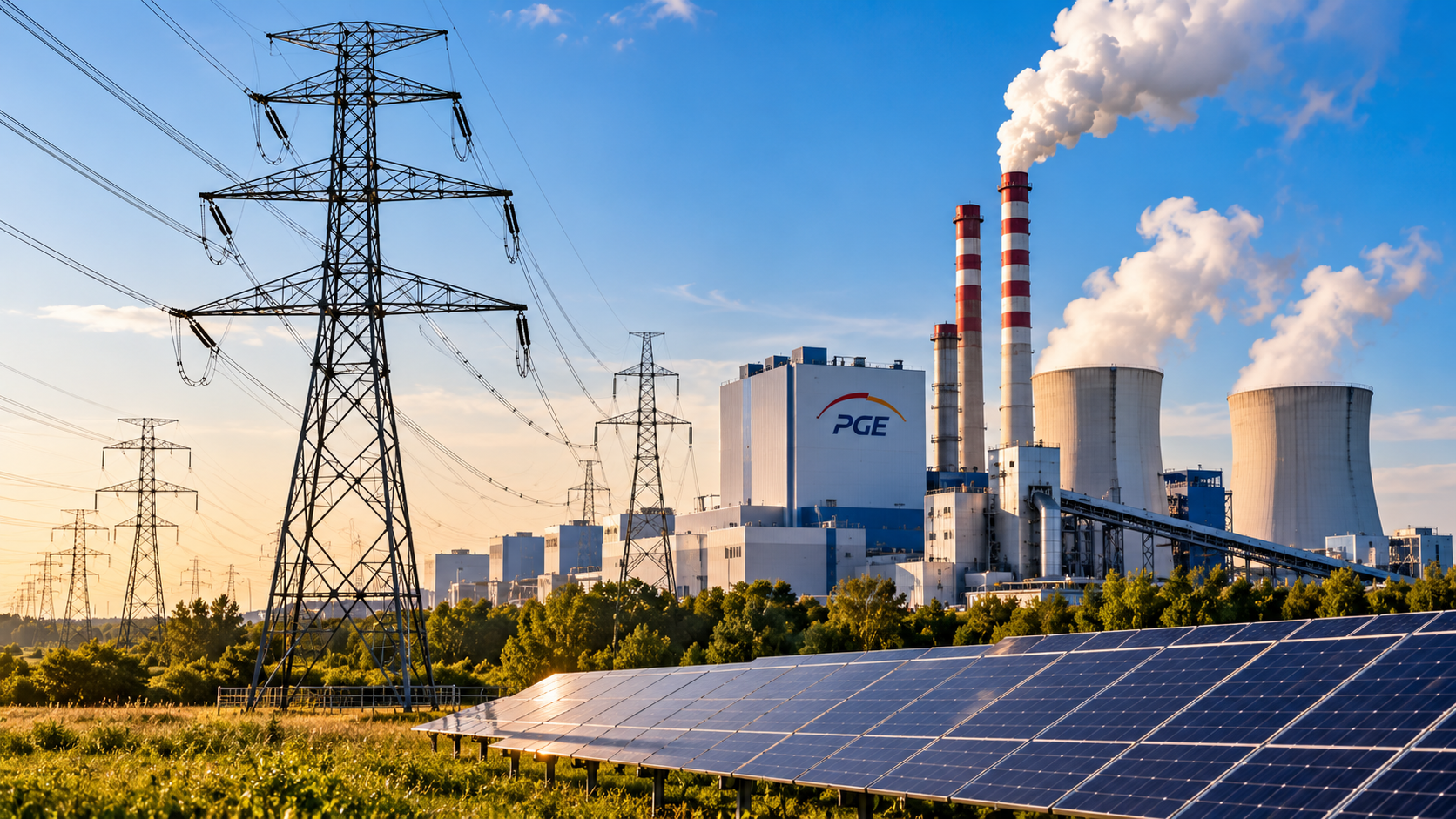
Polish energy group PGE has adopted an updated investment strategy worth approximately PLN 210 billion ($53.9 billion or €48.1 billion) through 2035, outlining plans to expand renewable electricity, power networks, gas generation and energy storage while preparing to resume dividend payments to shareholders.
The strategy, approved on Monday, 19 October, sets out planned capital expenditure between 2025 and 2035 and establishes new financial targets for one of Poland’s largest energy companies.
PGE intends to direct PLN 80 billion towards renewable energy and storage, PLN 70 billion towards network infrastructure and PLN 48 billion towards stable, lower-emission generation, including gas-fired power plants, district heating and nuclear-related activities.
The company is also targeting annual earnings before interest, tax, depreciation and amortisation (EBITDA) of more than PLN 30 billion by 2035.
For investors, another significant change is PGE’s stated intention to resume dividends from profits generated in 2026, with an indicated dividend yield capped at 5%.
However, the dividend has not been declared or approved, and the investment figures represent a long-term corporate programme rather than expenditure already completed.
PLN 210bn programme reshapes investment priorities
According to PGE’s stock-market disclosure, report 63/2026, the updated strategy is built around three priorities: growth through electrification, transformation of the company’s asset portfolio and greater investment and operational efficiency.
Its investment programme covers five main areas.
| Investment area | Planned expenditure, 2025–2035 |
|---|---|
| Renewable energy and energy storage | PLN 80bn |
| Electricity networks and infrastructure | PLN 70bn |
| Stable lower-emission generation | PLN 48bn |
| Customer energy solutions | PLN 6bn |
| Coal operations — maintenance expenditure | PLN 5bn |
| Total programme | Approximately PLN 210bn |
The individual figures total PLN 209 billion, consistent with the company’s rounded headline target of approximately PLN 210 billion.
The network category includes electricity distribution and railway-related infrastructure, while the lower-emission generation category covers gas power, heating and nuclear-related activities.
The inclusion of PLN 5 billion for maintaining coal-generation assets also demonstrates that conventional generation remains part of the company’s transition programme.
PGE’s announcement initially contained a material error in the renewable energy and storage figure.
The original Polish-language disclosure incorrectly stated PLN 80 million rather than PLN 80 billion.
The company issued a formal stock-market correction at 14:25 on 19 October, confirming the correct amount as PLN 80 billion. The English-language version had already contained the correct figure.
The clarification is important because renewables and storage account for the largest individual allocation in the revised programme.
Investment target reduced from previous strategy
The new programme represents a revision of the strategy PGE adopted in June 2025.
That earlier corporate strategy envisaged approximately PLN 235 billion of investment to 2035, including development expenditure, acquisitions and additional investment options.
The updated headline programme is PLN 25 billion lower.
However, PGE has revised its investment classifications and strategic priorities, meaning the change should not automatically be interpreted as the cancellation of PLN 25 billion of specific projects.
For example, the earlier strategy identified separate allocations for renewables, gas generation, storage and heating. The new strategy consolidates some of those activities into broader categories.
A detailed comparison of individual projects will require the complete revised strategy and subsequent investment disclosures.
The new PLN 210 billion figure also includes the period beginning in 2025. It should not be presented as an additional amount that PGE intends to spend entirely after October 2026.
Electricity networks and energy storage are central
The updated strategy gives considerable importance to expanding the infrastructure required to connect new electricity generation and customers.
PGE plans PLN 70 billion of expenditure on network infrastructure and aims to connect an additional 11 gigawatts of renewable generation capacity to its networks by 2035.
That target concerns new renewable capacity connected to PGE’s network, not necessarily power stations owned directly by the company.
It reflects the growing need for distribution infrastructure capable of supporting renewable energy projects, businesses and increasingly electrified industrial operations.
The company also intends to achieve 18 gigawatt-hours of energy-storage capacity by 2035.
Energy storage can help manage fluctuations in electricity supply and demand, particularly where generation increasingly depends on weather-sensitive sources such as wind and solar power.
Storage facilities can absorb electricity when it is available and release it when the system requires additional supply.
The capacity target is expressed in gigawatt-hours, which measure the amount of energy that can be stored. This differs from gigawatts, which measure the rate at which electricity can be generated or delivered.
PGE also aims to produce 28 terawatt-hours of renewable electricity annually from installations and projects developed by the group, including projects involving investment partners.
That production target is forward-looking and includes the output attributable to the specified projects regardless of partners’ ownership shares.
Gas generation remains part of the energy transition
Alongside renewables and storage, PGE is planning continued development of flexible gas-fired electricity generation.
The group is targeting 9.6 gigawatts of flexible gas-generation capacity.
Such power stations can adjust output to help balance the electricity system when renewable production changes.
The strategy groups gas generation with heating and nuclear-related activities under the PLN 48 billion allocation for stable lower-emission generation.
Gas power plants generally produce less carbon dioxide than coal-fired generation for the same amount of electricity, although they still burn fossil fuels and generate greenhouse-gas emissions.
Their long-term economic viability can depend on fuel prices, emissions costs, electricity-market conditions and the availability of capacity-market support.
Capacity-market arrangements compensate eligible power providers for making dependable generating capacity available to support security of supply, rather than paying solely for electricity produced.
PGE is also retaining nuclear energy as a strategic option.
The strategy includes potential services for Poland’s planned second large nuclear power station and work connected with small modular reactor technology.
Those ambitions should not be interpreted as confirmed investment decisions for individual nuclear projects.
Dividend return becomes a financial priority
For shareholders, the revised strategy introduces a more specific timetable for the potential return of cash distributions.
PGE says it intends to resume dividend payments from the profit generated during the 2026 financial year, with a dividend yield not exceeding 5%.
This does not mean shareholders have been promised a 5% payment.
Dividend yield measures an annual dividend relative to the company’s share price. It is not the percentage of annual profit automatically distributed.
Any payment from 2026 earnings would ordinarily require the relevant financial results, a profit-allocation proposal and approval through the company’s corporate decision-making process.
That means the first potential payment under the new policy would follow the 2026 financial year, rather than constitute a dividend already authorised in October.
The strategy also sets a maximum net debt-to-EBITDA ratio of 2.8 and aims to preserve an investment-grade credit rating.
The debt ratio compares the company’s net financial borrowing with its annual operating earnings measure.
These financial constraints matter because PGE must balance substantial infrastructure spending against debt servicing, access to financing and potential distributions to investors.
Whether the dividend objective is achieved will depend on financial performance, cash generation, investment commitments and the necessary corporate approvals.
Earnings targets rise to more than PLN 30bn
PGE has set a cumulative EBITDA target of approximately PLN 209 billion across 2025–2035.
Within that period, it forecasts annual EBITDA of approximately PLN 15 billion in 2030 and more than PLN 30 billion in 2035.
EBITDA is a measure of earnings before interest, tax, depreciation and amortisation.
It provides an indication of operating financial performance but is not the same as net profit or free cash flow.
The distinction is particularly important for capital-intensive energy companies because investment spending, financing costs and depreciation can materially affect the cash available for dividends.
The company has also outlined an efficiency programme with targeted cumulative optimisation benefits of PLN 19 billion.
PGE expects regulated or contract-based arrangements to play an important role in supporting investment returns.
Its strategy envisages recovering value associated with more than 70% of investment expenditure through mechanisms including regulated tariffs and contracts for difference.
Electricity distribution tariffs provide a regulated framework for network-related revenues, while contracts for difference can offer eligible generation projects greater revenue predictability.
This does not mean that 70% of PGE’s investment programme will be paid for through direct government subsidies.
For projects exposed more directly to electricity and capacity markets, the company identifies target internal rates of return of 7–9%, with higher return expectations for certain other investments.
These remain corporate financial assumptions, not guaranteed investment outcomes.
PGE positions itself for Poland’s digital economy
A notable feature of the updated strategy is PGE’s ambition to support the electricity requirements of data centres, artificial intelligence and increasingly digital business activity.
The company sees opportunities not only in supplying electricity but also in developing infrastructure and services for energy-intensive digital facilities.
Data centres require substantial, reliable electricity supplies, suitable grid connections and increasingly sophisticated cooling and energy-management systems.
For an electricity producer and infrastructure operator, this creates potential demand for new commercial services and supporting investment.
The strategy builds on activities already announced by the company.
Earlier in October, PGE and state research institute NASK agreed to explore a network of Polish data centres, potentially using existing PGE industrial sites and recovering waste heat for district-heating systems.
The partnership remains at the cooperation and development-assessment stage.
The updated strategy gives such activities a broader corporate context but does not establish that the proposed data centres have entered construction or commercial operation.
Domestic suppliers targeted for investment programme
PGE is also seeking to increase the participation of Polish businesses in its investment supply chains.
The company has set a target of at least 65% domestic participation over the lifecycle of its investment projects.
That objective could be relevant to Polish engineering contractors, construction companies, energy-equipment manufacturers and service providers.
Potential opportunities include electricity networks, renewable-generation facilities, battery storage, gas-generation infrastructure and industrial energy services.
However, the target concerns domestic participation across the investment lifecycle. It does not establish that 65% of every individual contract must be awarded to Polish companies.
Nor does it guarantee a particular number of jobs or a fixed value of contracts for named suppliers.
Actual commercial opportunities will depend on future procurement procedures, technical requirements, financing arrangements and project implementation.
Next decisions will determine delivery
The revised strategy establishes the direction of PGE’s investment and shareholder policy through 2035, but its targets remain dependent on execution.
The company will need to secure financing, manage construction schedules, obtain relevant permissions and respond to changing energy-market conditions.
Regulatory tariffs, electricity prices, fuel costs and the availability of investment support will also influence the financial results of different business segments.
PGE said the complete updated strategy document would be published on its website.
Its publication should provide additional detail about project assumptions, capital allocation and the changes from the June 2025 strategy.
For investors, the next important developments will include the company’s financial results and any formal dividend proposal relating to 2026 profits.
For Poland’s wider industrial economy, the more significant long-term test will be how much of the planned PLN 210 billion programme translates into completed energy infrastructure, reliable generating capacity and contracts for suppliers.
For now, PGE has adopted an ambitious investment and financial strategy, but neither its future expenditure nor its proposed shareholder distributions should be treated as completed commitments.