
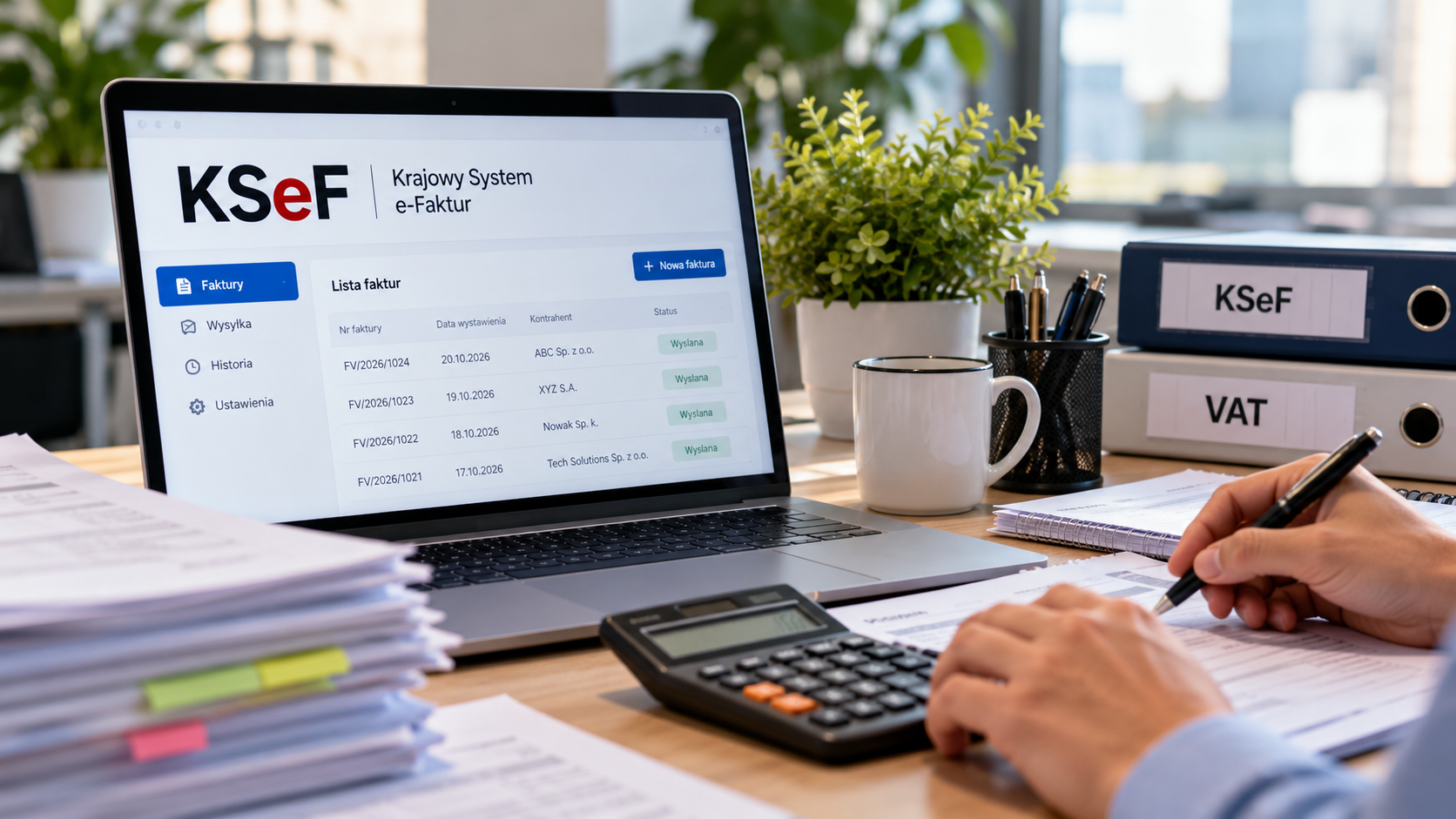
Poland’s government has approved draft legislation postponing financial penalties for violations of the country’s mandatory electronic-invoicing rules until 1 January 2028, giving businesses another year to adapt without removing their obligation to use the system.
The Council of Ministers adopted the amendment on Tuesday, 20 October 2026, and the government submitted it to the Sejm, the lower house of Poland’s parliament, the same day.
The proposal would extend the existing transitional protection against financial penalties associated with the National e-Invoicing System, known as KSeF, until 31 December 2027.
The Finance Ministry confirmed the Cabinet decision, emphasising that mandatory electronic invoicing would remain in force and that tax authorities could still investigate businesses failing to comply with their VAT obligations.
The legislation also proposes extending Poland’s reverse-charge VAT mechanism for specified electricity, gas and emissions-allowance transactions until June 2030.
The bill has not yet become law. It must complete the parliamentary and presidential stages before the amended penalty timetable can take legal effect.
Cabinet approval moves KSeF proposal forward
The government’s decision marks the latest stage in a regulatory change first proposed by the Finance Ministry in September.
As Poland 24 Business previously reported, legislative project UD477 proposed moving the start of dedicated KSeF financial penalties from January 2027 to January 2028.
The proposal has now passed the Cabinet stage.
According to the Prime Minister’s Office, the amendment responds to concerns raised by businesses encountering technical and organisational difficulties during the introduction of compulsory electronic invoicing.
The additional transition period is intended to allow companies to improve their accounting procedures, electronic systems and internal controls before the dedicated monetary-penalty provisions begin applying.
The government has published the approved legislative package and recorded its submission to Parliament on 20 October.
The proposed commencement date is 31 December 2026.
That leaves a relatively short period for the remaining legislative process before the penalty provisions currently scheduled for January 2027 would otherwise take effect.
Mandatory KSeF deadlines remain unchanged
The most important practical distinction is that the proposal delays penalties, not the underlying invoicing obligation.
Poland introduced mandatory structured electronic invoicing through KSeF in stages during 2026.
The implementation timetable remains:
| Date | KSeF requirement |
|---|---|
| 1 February 2026 | Mandatory issuance began for businesses whose gross sales exceeded PLN 200m in 2024. |
| 1 April 2026 | The obligation expanded to most other businesses, subject to statutory exceptions. |
| 1 January 2027 | The temporary exemption for the smallest businesses, based on a PLN 10,000 monthly invoiced-sales threshold, is scheduled to expire. |
| 1 January 2028 | The dedicated financial penalties would begin applying under the newly approved government proposal, if enacted. |
For the smallest businesses, the coming January deadline remains especially important.
Until the end of 2026, certain taxpayers can issue invoices outside KSeF where the monthly gross value of sales documented by those invoices does not exceed PLN 10,000 — approximately $2,600 or €2,300.
That threshold concerns the relevant invoiced sales, not necessarily a company’s entire turnover.
Under the current implementation timetable, this transitional exemption will end on 31 December 2026.
The same deadline also ends the temporary arrangements allowing specified invoices to continue being issued using cash registers.
Consequently, businesses benefiting from these exceptions must still prepare for the January change.
The Finance Ministry’s official implementation guidance explains the different stages and the requirements applying to each group of taxpayers.
Which financial penalties would be delayed?
The proposed extension concerns the dedicated monetary penalties specified in Article 106ni of Poland’s VAT Act.
These provisions address particular failures involving mandatory structured electronic invoices.
They include cases where a taxpayer required to use KSeF fails to issue an invoice through the system, issues an invoice incorrectly during an authorised offline or outage procedure, or fails to transmit an offline invoice within the required statutory deadline.
Under the penalty framework, the head of a tax office can impose a financial penalty of up to 100% of the VAT amount shown on an affected invoice.
Where an invoice does not show a VAT amount, the penalty can reach 18.7% of the total amount due.
These are statutory upper limits, not automatic charges applied to every error.
The government’s legislative register for UD477 identifies the relevant provisions as Article 106ni, paragraphs 1–3 and 5–7.
The existing legislation provides for their application from 1 January 2027.
Under the new proposal, that would shift to 1 January 2028.
The extension is therefore focused on a specific financial-sanction regime. It does not suspend the VAT Act more broadly or prevent enforcement of other tax obligations.
Tax authorities could still investigate non-compliance
Businesses should not interpret the proposed extension as permission to ignore KSeF throughout 2027.
The Ministry of Finance has explicitly stated that Poland’s National Revenue Administration, known as KAS, will continue responding when businesses issue invoices outside KSeF despite being legally required to use the system.
The government’s intended approach places greater initial emphasis on communication and compliance support.
Tax authorities would first remind businesses of their obligations and provide information about the correct procedures.
Where a taxpayer fails to respond, the authorities could check whether the failure to use KSeF is associated with incorrect or unreliable VAT settlements.
This means the proposed protection against dedicated KSeF financial penalties would not provide immunity against investigations into tax irregularities.
Businesses would remain responsible for correctly calculating and paying VAT, maintaining appropriate records and meeting their other statutory obligations.
The Finance Ministry’s existing KSeF guidance also confirms that issuing an invoice outside the system, contrary to the applicable rules, does not remove the underlying obligation to account for VAT on the transaction.
For businesses and accounting departments, the difference is significant: the proposal would reduce exposure to one category of financial penalty while leaving the core compliance requirements in place.
What the additional year means for businesses
If the amendment is enacted, companies would gain another year before the dedicated KSeF monetary penalties begin applying.
For businesses already using KSeF, that could provide more time to correct recurring problems involving invoice generation, data validation, accounting-system integration and offline procedures.
For smaller companies entering mandatory electronic invoicing in January 2027, the extension would allow them to begin using the system without immediately becoming subject to the Article 106ni financial penalties.
However, neither group should treat the delay as a reason to postpone implementation.
Businesses still need to ensure that their invoicing software supports the required structured format and that staff understand when invoices must be transmitted through KSeF.
Companies using external accountants or accounting-service providers should also establish who is responsible for issuing invoices, managing authorisations and addressing technical failures.
International groups with Polish operations may face additional coordination requirements where invoicing and accounting functions are managed through central systems outside Poland.
The relevant Polish invoicing obligations continue to depend on the taxpayer and transaction, rather than simply the nationality of the business owner.
The Finance Ministry maintains free KSeF tools and publishes technical guidance to support implementation.
VAT reverse charge also extended under the proposal
The Cabinet-approved bill includes a second measure affecting businesses operating in energy and emissions markets.
It proposes extending Poland’s temporary VAT reverse-charge arrangements for specified transactions until 30 June 2030.
The measure concerns transactions involving gas supplied through the gas system, electricity and services involving the transfer of greenhouse-gas emissions allowances.
Under the reverse-charge mechanism, the obligation to account for VAT is transferred from the seller to the buyer or service recipient in qualifying transactions.
The system is intended to reduce opportunities for VAT fraud and support more effective tax control in certain organised energy markets.
Poland introduced the temporary arrangements in April 2023, and their present expiry date is 31 December 2026.
Without an extension, the relevant domestic rules would cease applying after that date.
The government argues that continuing the mechanism would help prevent fraud, maintain the competitiveness of Polish energy-market participants and avoid additional administrative and financing costs.
However, the proposal also has an EU-law dimension.
The relevant Polish rules rely on Article 199a of the EU VAT Directive, which currently permits specified temporary reverse-charge arrangements until the end of 2026.
Work is under way at EU level to extend that authorisation.
The Polish government’s legislative documentation acknowledges that the proposed domestic end date may need to change if the final EU arrangements establish a different timetable.
The reverse-charge extension should therefore be treated as a proposed continuation of an existing targeted mechanism, not a general change to VAT accounting for all electricity or gas purchases.
Parliament must now consider the amendment
The Cabinet decision is a significant legislative milestone, but the proposal has not yet altered the law.
Following the government’s submission to the Sejm on 20 October, the legislation must proceed through the required parliamentary stages.
It would then require the remaining constitutional steps, including presidential consideration and publication in the Journal of Laws, before entering into force.
The government has proposed 31 December 2026 as the commencement date.
Until the amendment is enacted, the existing statutory timetable still provides for the dedicated KSeF financial penalties to begin applying on 1 January 2027.
For businesses, the immediate priority remains preparing for the electronic-invoicing obligations already in force or scheduled to begin in January.
The government’s decision increases the likelihood of an additional transition year without the dedicated KSeF penalties, but it does not yet make that postponement legally binding.